
TLDR: Google Search Console now includes reporting features for social media and video platforms.
Announced: July 7, 2026, by Moshe Samet, Product Manager Lead at Google Search Console.
What launched: Google Search Console platform properties: a new property type that lets creators verify Instagram, TikTok, X, and YouTube accounts directly, no website required.
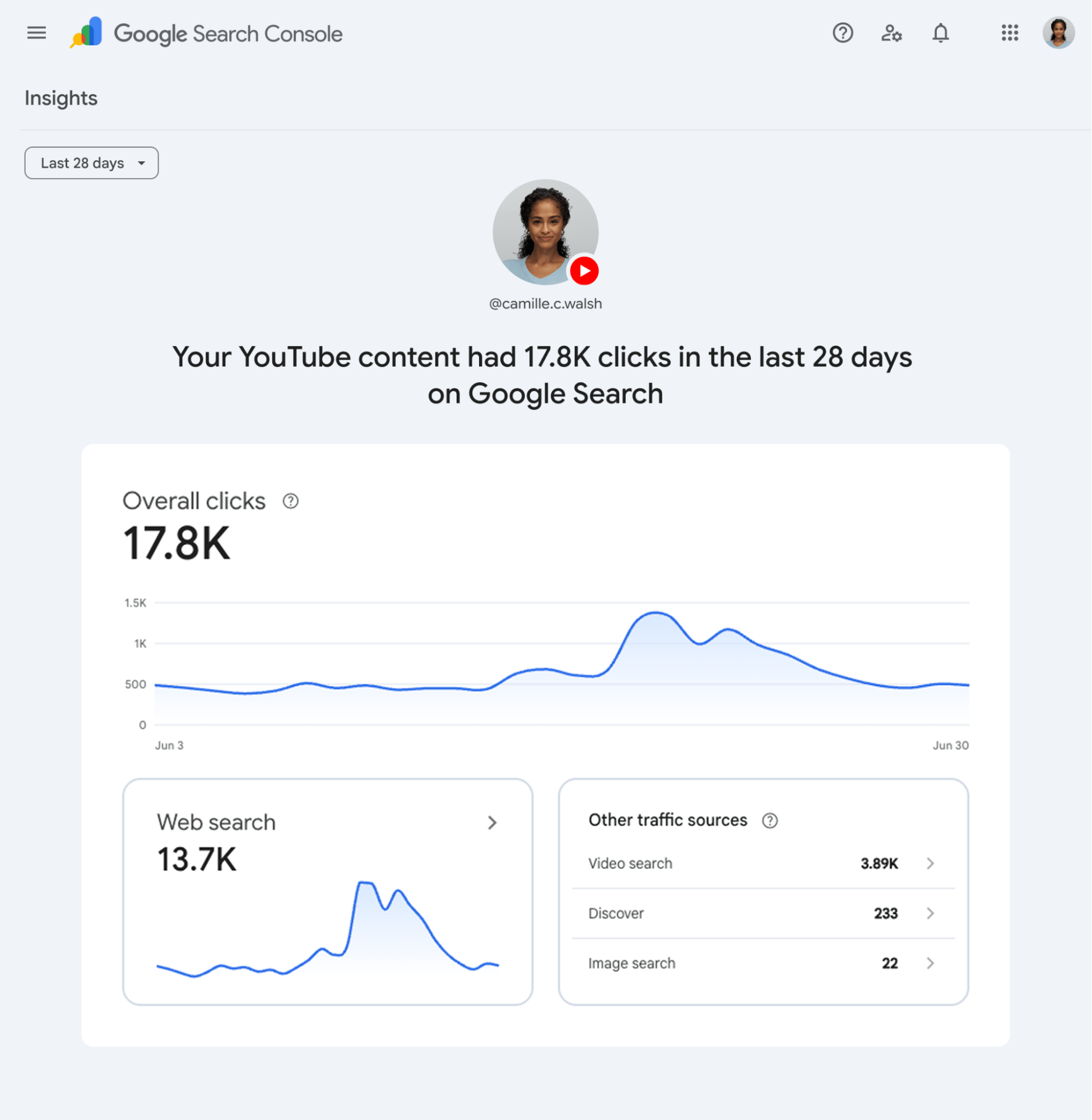
What you get: Performance report (clicks, impressions, queries), Insights report (top posts, traffic trends), and Achievements (milestone tracking).
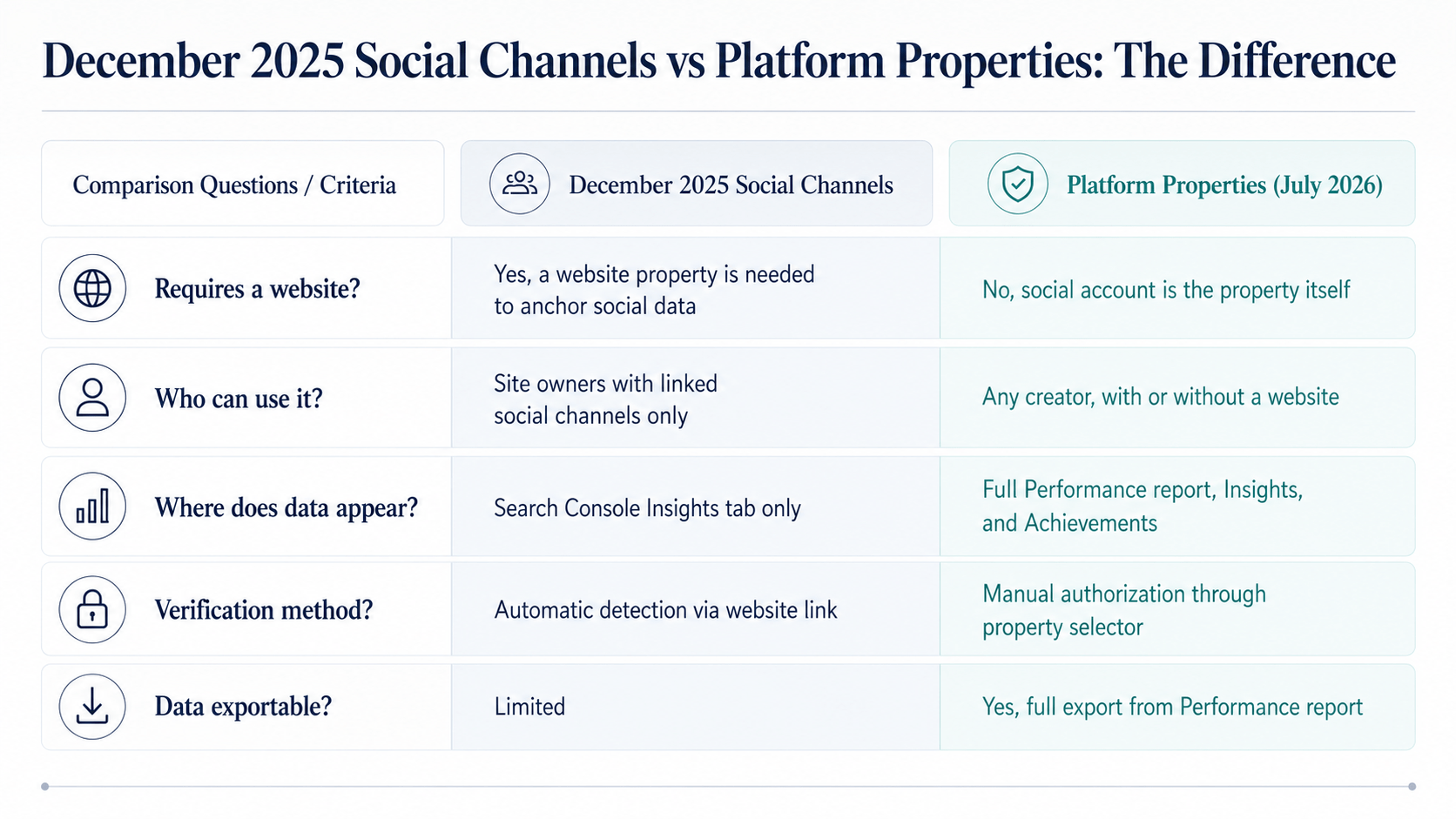
What changed vs December 2025: December required a website to anchor social data. Platform properties remove that requirement entirely.
Rollout: Gradual over coming weeks. Not live for all accounts yet.
What it signals: Google is formally acknowledging that a search presence and a website are two different things.
Platform properties let creators track performance on Instagram, TikTok, X, and YouTube in Search. No site required.
For years, Search Console assumed one thing about you: that you own a website. That assumption just broke.
On July 7, 2026, Google’s Search Console Product Manager Lead, Moshe Samet, announced platform properties, a new Search Console property type built for creators and publishers who reach audiences through social and video content, not just a domain. If you run an Instagram account, a TikTok, an X profile, or a YouTube channel, you can now verify it directly in Search Console and see how it performs on Google Search and Discover. No website. No workaround. Just the platform account itself, treated the same way Google treats a verified site.
What Actually Changed
This builds on an experiment Google rolled out in December 2025, which let site owners see performance data for social channels linked to their existing website property. That was useful, but it still required a website to hang the data on. Platform properties remove that requirement entirely. A creator with zero web presence can now claim their Instagram or YouTube account as its own Search Console property and get real search performance data against it.
That is the actual shift here. Not “Google now cares about social”; it already did that in December. This is Google formally acknowledging that a search presence and a website are two different things, and building tooling to treat them that way.
Context worth knowing: Google also launched Search Profiles in June 2026, a separate but related feature that lets creators link social accounts to create a unified discovery hub that can trigger a Google Knowledge Panel. Platform properties in Search Console are the measurement layer. Search Profiles are the visibility layer. They are distinct products. The official blog post by Moshe Samet explicitly states: platform properties are different from Search profiles, which have their own analytics.
What You Get in the Report
Once a platform property is verified, three reports become available:| Report | What It Shows | Who It Is For |
| Performance report | Total clicks, impressions, and the specific posts and search queries driving the most traffic. Exportable for custom reporting stacks. | SEOs, agencies, brand managers tracking search-driven content performance |
| Insights report | A rollup of recent traffic trends, top-performing posts, and how people are finding the account through Google Search and Discover. | Content teams and creators who need a fast read on what is working |
| Achievements | Milestone tracking such as crossing a new 28-day click threshold. | Creator-facing feature, less relevant for agency or brand reporting |
Why This Matters Beyond the Feature List
Search behavior has been fracturing away from the traditional SERP for years. People search inside TikTok. They search inside Instagram. They ask a question and land on a YouTube video before they ever reach a website. Google has been slow to admit that in its own products.Platform properties is the clearest admission yet.The reporting gap it closes: Before this, measuring Google Search-driven traffic to social content meant piecing together platform-native analytics, referral traffic estimates, and guesswork. Now you get actual clicks, impressions, and queries from Google directly against your social content. That is a fundamentally better data source for deciding which content format is earning discovery, not just engagement.
For agencies and in-house marketers, this changes what you can report to clients. You can now pull actual Search-driven performance for social content and show it alongside traditional organic metrics in the same tool.
For creators who never had a reason to touch Search Console, this is the first reason. If your entire footprint lives on TikTok or Instagram, you now have a way to see how Google is surfacing that content, something that was previously completely invisible.
This connects to the broader shift in how Google evaluates content in 2026. The Google May 2026 Core Update explicitly rewarded content that exists as a genuine source of value wherever it lives, website or not. Platform properties is the measurement infrastructure that makes that visible for the first time.
What to Do Now
The rollout is gradual, but you shouldn’t treat this with a “wait and see” attitude. Google Search Console data does not backdate. The longer you wait to verify your platforms, the more crucial launch data you lose forever.
Here are the actions worth taking immediately:
- Check your access daily: Open Search Console and click your property selector dropdown. If you see the platform properties option, your account is live.
- Verify immediately upon access: Connect your Instagram, TikTok, X, and YouTube accounts the second the option drops. The earlier you start collecting data, the faster you can map out which posts are earning search visibility instead of just surface-level engagement.
- Flag this for clients: For agencies, loop in any clients using social as a core channel. They need to understand that their historical search benchmarks start the day they click authorize.
- Establish a Day 1 baseline: Record your initial impressions and clicks immediately after verification so you have a clean starting point for your monthly or quarterly reporting.
If your brand has been building social presence without visibility into how it performs on Google Search, this closes that gap. We covered what omnipresent B2B visibility looks like in practice; platform properties now give you the data to measure whether that presence is actually earning discovery.
Search stopped being one destination a long time ago. Google’s tooling is finally catching up.
Frequently Asked Questions
1. What are Google Search Console platform properties?
Platform properties are a new Search Console property type announced on July 7, 2026, by Google's Search Console Product Manager Lead Moshe Samet. They let creators and brands verify Instagram, TikTok, X, and YouTube accounts directly in Search Console without needing a website. Once verified, accounts appear as standalone properties with their own Performance report, Insights report, and Achievements section showing search-driven clicks, impressions, and queries.
2. Do I need a website to use Google Search Console platform properties?
No. That is the key change from the December 2025 experiment. The December feature required an existing website property to anchor social data. Platform properties remove that requirement entirely. A creator or brand with no web presence at all can now verify a social account directly in Search Console and get full search performance data.
3. How do I add Instagram to Google Search Console?
- Open Google Search Console and click the property selector dropdown.
- Select 'Add property' and choose Instagram from the four supported platform options.
- Follow the on-screen authorization steps to connect your account securely.
- Note that platform properties are rolling out gradually; if Instagram does not appear as an option yet, access has not reached your account.
- Google is expanding availability over the coming weeks.
4. Which platforms are supported by platform properties, and how do I verify them?
The four supported platforms at launch are Instagram, TikTok, X (formerly Twitter), and YouTube. To verify an account, open Google Search Console, expand the property selector dropdown, and click 'Add property'. Select your target platform from the list and follow the secure, on-screen authorization flow to link your account. Because the rollout is gradual over the coming weeks, don't panic if the options aren't visible in your dashboard just yet.
5. What is the difference between platform properties and the December 2025 social channels feature?
The December 2025 feature lets site owners see social performance data inside Search Console Insights, but only if they already had a website property. Platform properties are a separate property type that treats a social account as the primary property, with no website needed. The reports are also more comprehensive, including a full Performance report with exportable data.
6. What is the difference between platform properties and Google Search Profiles?
They are separate features confirmed as distinct in Google's own announcement. Search Profiles, launched in June 2026, are a public-facing visibility tool that lets creators link social accounts to create a unified discovery hub in Search results and potentially trigger a Knowledge Panel. Platform properties in Search Console are a private measurement tool that shows how your social content performs in Google Search. One is about how you appear. The other is about how you measure that appearance.
7. What is Google Search Console social media tracking?
Google Search Console social media tracking refers to the ability to see how your social media content on Instagram, TikTok, X, and YouTube performs specifically within Google Search and Discover. Platform properties, launched July 7, 2026, are the first dedicated tool for this inside Search Console. Previously, there was no direct way to attribute Google Search traffic to specific social posts or accounts.
Sources
- Google Search Central Blog: See How Content from Social and Video Platforms Performs on Google Search (Official, July 7, 2026, Moshe Samet)
- Search Engine Land: Google Search Console Gains Reporting on Social and Video Platforms
- Search Engine Journal: Google Search Console Adds Social Video Platform Properties
- Search Engine Roundtable: Google Search Console Now Shows Instagram, TikTok, X and YouTube Content Performance
- Softonic: Google Search Console Rolls Out Platform Properties, Social Profile Traffic Reports
- Tubefilter: Google’s Platform Properties Turn Search Data Into an Asset for Creators
- Visby AI: What Is the Google Search Console Platform Properties Feature?
- SEO Sherpa: Google Adds Social Channels to Search Console
Your Social Content Is on Google. Are You Measuring It?
c3digitus helps B2B and industrial brands build search visibility across every channel Google measures. If your social presence is not part of your SEO reporting yet, we can help fix that.