

In the digital age, if a picture is worth a thousand words, a minute of video is worth 1.8 million. This statistic, popularized by Forrester Research, isn’t just hyperbole—it’s a reflection of how the human brain processes information. We are wired for motion, for storytelling, and for human connection.
This guide will walk you through the entire landscape of video marketing, providing the granular detail you need to transform a simple “clip” into a powerful revenue-generating asset.
What is Video Marketing?
Video Marketing is the strategic integration of video content into your communication strategy to achieve specific business goals. However, to understand it fully, we must look at it through three distinct lenses:
- The Psychological Lens: Humans process visuals 60,000 times faster than text. Video triggers the mirror neuron system in our brains, allowing viewers to feel the emotions of the person on screen. This creates “Para-social interaction,” a sense of intimacy and trust between the viewer and the brand.
- The Technical Lens: It is a data-driven medium. Unlike a blog post, where you only know if someone landed on the page, video allows you to see exactly when someone stopped watching, what they re-watched, and where they clicked.
The Commercial Lens: It is a conversion engine. Whether it’s an ad on YouTube or an onboarding video in an app, video serves to reduce friction in the buyer’s journey by answering questions before they are asked.
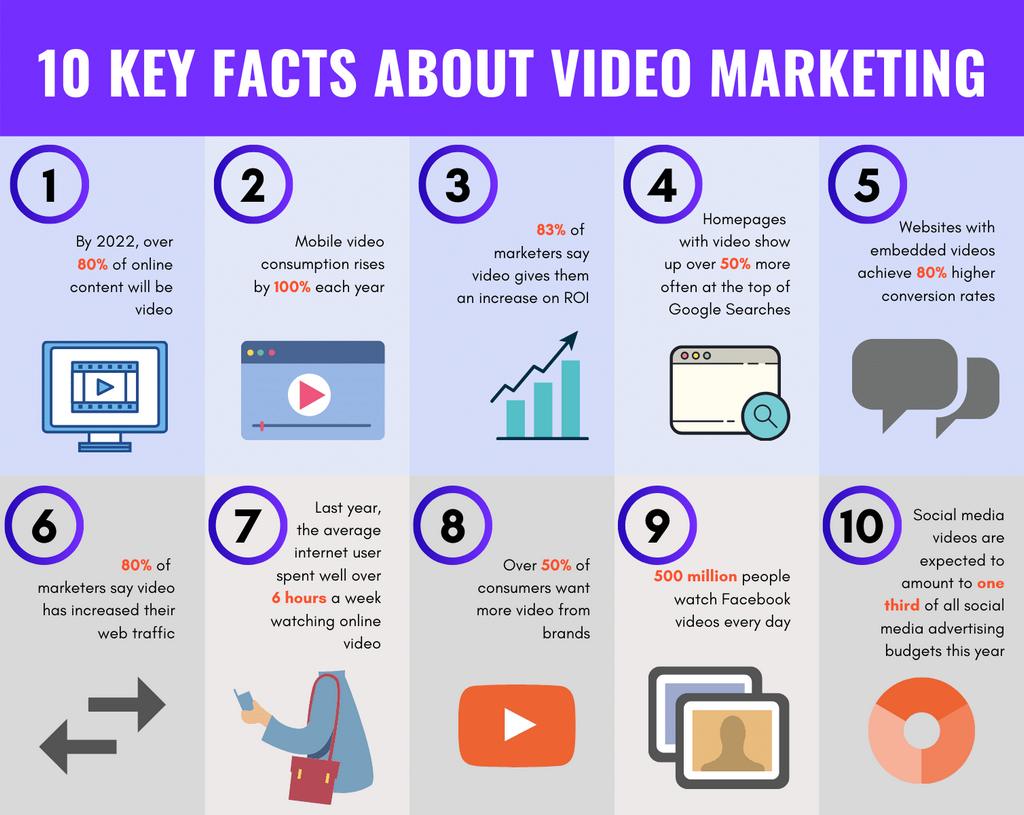
How Video Marketing Works: The Mechanics of Engagement
Video marketing operates on a cycle of Attention, Retention, and Conversion.
Phase 1: The Hook (0-3 Seconds)
On social media, “thumb-stopping” power is everything. The hook can be visual (a sudden movement), auditory (a bold statement), or intellectual (a question that identifies a pain point). If you don’t win the first three seconds, the rest of the video doesn’t matter.
Phase 2: The Value Delivery (The Meat)
Once you have their attention, you must fulfill the promise of the hook. This is where you provide the “Why” or “How.” The structure usually follows a Problem-Agitation-Solution (PAS) framework:
- Problem: Identify the viewer’s struggle.
- Agitation: Explain why that struggle is frustrating or costly.
- Solution: Introduce your product/service as the hero.
Phase 3: The Algorithm Loop
Platforms like TikTok and YouTube use “Watch Time” as their primary metric. If users watch your video to the end, the algorithm assumes the content is high-quality and pushes it to more people. This creates a “viral loop” that can lead to exponential organic growth.
Why is Video Marketing Important?
If you aren’t using video, you are essentially invisible to a large segment of the market. Here is the detailed breakdown of its importance:
- Emotional Connectivity: Text can be misinterpreted. Tone of voice and body language in a video convey sincerity, humor, and authority, which are essential for brand loyalty.
- Complex Simplification: Some products (like SaaS or medical devices) are hard to explain in text. Video allows you to use animations and walk-throughs to make the complex simple.
- Mobile-First World: Reading a 2,000-word article on a 6-inch screen is a chore. Watching a 2-minute video is an effortless experience.
- The “Amazon” Effect: Consumers now expect to see a video of a product before buying. Without it, they feel they are missing information, which leads to “cart abandonment.”
Different Types of Marketing Videos
To build a full-funnel strategy, you need to understand the nuances of these nine video categories:
Promotional Video
- Purpose: Brand Awareness.
- Detail: These are often “Top of Funnel” (ToFu) assets. They don’t usually ask for a sale immediately; instead, they focus on brand personality. Think of the famous Dollar Shave Club ad—it didn’t just sell razors; it sold a vibe.
Video for Explanation (The Explainer)
- Purpose: Education and Lead Gen.
- Detail: Usually 60–90 seconds long. It follows a strict script: The Hook, The Problem, The Solution, The How-it-works, and the CTA. These are best as 2D animations or “talking head” styles with heavy graphics.
Tutorial Video (The “How-To”)
- Purpose: Customer Success and Authority.
- Detail: These are “Middle of Funnel” (MoFu) assets. They establish you as a helpful resource. By teaching your audience for free, you build “Reciprocity”—the psychological urge for them to give back to you (usually by buying your product).
Testimonial Video
- Purpose: Trust and Closing.
- Detail: The most effective testimonials aren’t just people saying “this is great.” They are “Before and After” stories. The customer explains their life before your product, the moment they decided to try it, and the transformation they experienced after.
Live Video
- Purpose: Community and Urgency.
- Detail: Live video (Instagram, LinkedIn, Twitch) creates FOMO (Fear Of Missing Out). It’s unpolished, which makes it feel more authentic and honest.
Behind-the-Scenes (BTS)
- Purpose: Humanization.
- Detail: Show the “messy” side of the business. Packing orders, team meetings, or the CEO’s morning routine. This builds a “tribe” rather than just a customer base.
Virtual Video and Webinars
- Purpose: High-Ticket Sales.
- Detail: Webinars are the gold standard for B2B. They allow for an hour of “indoctrination” where you can thoroughly explain your philosophy and handle every possible objection in the Q&A.
Interactive Video
- Purpose: Data Collection.
- Detail: Using tools like Mindstamp or Adventr, you can let viewers choose their own path. This provides you with incredible data: you can see exactly which features your audience is most interested in based on what they click.
Product Demonstration Video
- Purpose: Decision Support.
- Detail: This is “Bottom of Funnel” (BoFu). It should be clear, high-definition, and focus on the “User Experience.” Show the buttons, the interface, or the texture of the fabric.
What are the Benefits of Video Marketing?

Video marketing delivers measurable benefits at every stage of the customer journey, from first interaction to long-term loyalty.
- Increased Engagement: Videos naturally capture attention faster than text or images. Motion, visuals, and sound encourage viewers to stay longer, interact more, and engage with content through likes, shares, and comments.
- Stronger Brand Awareness: Visual storytelling helps audiences recognize and remember brands more easily. Consistent video style, tone, and messaging reinforce brand identity and improve recall across multiple platforms.
- Higher Conversion Rates: Videos help customers make confident decisions by clearly showcasing product benefits, real-world use cases, and value propositions. This clarity reduces hesitation and improves conversion rates.
- Better Customer Education: Complex information becomes easier to understand when explained visually. Videos simplify features, processes, and instructions, helping customers learn faster and with less confusion.
- Emotional Connection: Videos connect emotionally, not just logically. Tone of voice, facial expressions, and storytelling create trust and relatability, strengthening the relationship between brands and audiences.
- Long-Term ROI: Well-optimized videos continue generating traffic, leads, and engagement long after they are published. Evergreen video content delivers ongoing value and compounds returns over time.
How does video marketing help in SEO?
Video marketing is honestly one of the most powerful “secret weapons” in modern SEO because it hits so many different ranking factors at once. When you think about how we browse the web today, most of us would much rather watch a quick two-minute explainer than trudge through a 2,000-word article. Search engines like Google have picked up on this preference, which is why they’ve started prioritizing pages that include high-quality video content. By giving people what they want, you’re essentially telling Google that your page is a valuable destination.
One of the biggest ways video helps is by boosting dwell time, which is just a fancy way of saying how long someone stays on your site. If a visitor lands on your page and immediately starts watching a video, they’re staying active on your site for several minutes instead of hitting the “back” button after five seconds. To a search engine, that long stay is a huge gold star; it signals that your content is relevant and engaging, which can help nudge your overall rankings higher.
It’s also worth noting that video gives you “double the real estate” in search results. When you optimize your video correctly—using the right keywords in the title, description, and tags—you aren’t just trying to rank your webpage; you’re also trying to get that video to show up in the Video tab or as a rich snippet on the main results page. These little video thumbnails are eye-catching and naturally have a higher click-through rate than plain text links, meaning you’re grabbing more traffic from the same search query.
In the rapidly evolving landscape of AI-driven search, video is becoming an even more critical asset. AI search engines and “Answer Engines” (like Google’s AI Overviews) are designed to provide the most comprehensive answer possible. Because these AI models can now “crawl” and transcribe the audio and visual data within a video, they use that information to satisfy complex user queries. Having a video with a clear transcript or structured chapters makes it much easier for an AI to pull your content as the definitive source for its generated summary.
Furthermore, as AI-generated text becomes more common across the web, human presence is becoming a premium ranking signal. Video offers a level of “Proof of Human” that text often lacks. When users see a real person speaking or a physical product being demonstrated, it builds a level of trust and authenticity that AI models recognize through user engagement signals. In a world of automated content, video serves as a hallmark of high-effort, authoritative information that AI systems are increasingly programmed to prioritize.
Lastly, video is a magnet for backlinks and social shares. People are far more likely to share a helpful or entertaining video than a static blog post. When other websites embed your video or link back to your page because they found your visual content useful, it builds your site’s authority. In the eyes of an algorithm, those links are like votes of confidence, making your entire website seem more trustworthy and authoritative in your niche.
Video Marketing Statistics
Adoption Rates: 89% of businesses use video marketing in 2025, down slightly from 91% in 2024 but still showing widespread integration. 55% of small businesses leverage it, while 68% of non-users plan to start in 2025.
Spending Trends: Short-form digital video spending will reach $111 billion in 2025, up 12% year-over-year. Global digital video ad spend is projected to exceed $207.5 billion by year-end, with an average of nearly $35 per internet user.
ROI Metrics: 93% of marketers report strong ROI from video marketing efforts. 84% of businesses say video directly increases sales, and 82% note boosted website traffic.
Platform Usage: Company websites top sharing platforms at 67%, followed by email (49%) and LinkedIn (43%). YouTube leads as the top-performing channel, with 90% of B2B marketers using it.
AI and Production Trends: 51% of marketers use AI for video creation or editing, with auto-captions as the top use (59%). 55% produce videos in-house, and short-form videos like Reels top investment plans for 2025 (17.13%).
Video type: Short-form videos such as TikTok, Instagram Reels, and YouTube Shorts are the most popular video formats among marketers, with 29.18% actively using them in their strategies. Additionally, 19.19% of marketers include live streaming as part of their content approach.
Video Sharing: Company websites are the primary platform for sharing video content, with 67% of businesses using them. This is followed by email marketing at 49%, LinkedIn at 43%, YouTube at 40%, Instagram at 22%, Facebook at 19%, TikTok at 7%, and X at 4%.
How to develop a Video Marketing Strategy?
A strong video marketing strategy is not about creating random videos and hoping they perform well. It is about building a structured, goal-driven system that delivers consistent results over time. Businesses that succeed with video marketing treat it as a long-term investment, not a one-off campaign.
Below is a step-by-step breakdown of how to build a video marketing strategy that aligns with business goals, audience needs, and measurable outcomes.

1. Define Clear Objectives
The foundation of any successful video marketing strategy is clarity of purpose. Every video you create should have a clearly defined goal tied directly to your broader business objectives.
Common video marketing objectives include:
- Increasing brand awareness
- Educating potential customers
- Generating qualified leads
- Driving product or service sales
- Improving customer retention and loyalty
For example:
- If your goal is brand awareness, your videos should focus on storytelling, brand values, and broad industry problems.
- If your goal is lead generation, your videos should include clear calls-to-action such as sign-ups, downloads, or demo requests.
- If your goal is sales, your videos should address objections, showcase benefits, and demonstrate real-world value.
Clearly defined objectives help you decide:
- What type of video to create
- How long the video should be
- Which platform it should be published on
- How success will be measured
Without clear objectives, video marketing becomes activity-driven instead of result-driven.
2. Map Videos to the Marketing Funnel
Not all videos serve the same purpose. A strong strategy maps different video types to each stage of the customer journey.
Awareness Stage
At this stage, people are discovering your brand for the first time. They may not even know they have a problem yet.
Best video types:
- Brand introduction videos
- Short educational videos
- Social media videos
- Industry trend videos
Goal: Capture attention and build familiarity
Consideration Stage
Here, potential customers are comparing solutions and learning more about their options.
Best video types:
- Explainer videos
- Product overview videos
- Comparison videos
- Educational webinars
Goal: Build trust and demonstrate expertise
Conversion Stage
At this stage, prospects are close to making a purchase decision.
Best video types:
- Product demonstration videos
- Testimonial and case study videos
- FAQ and objection-handling videos
Goal: Remove hesitation and drive action
Retention Stage
Video marketing doesn’t stop after the sale. Retention-focused videos help turn customers into loyal advocates.
Best video types:
- Onboarding videos
- Tutorial and how-to videos
- Feature update videos
- Customer success stories
Goal: Increase lifetime value and loyalty
Mapping videos to the funnel ensures your content supports users at every decision-making stage instead of focusing only on sales.

3. Create a Content Calendar
Consistency is one of the biggest success factors in video marketing. A content calendar helps you stay organized, realistic, and consistent.
A strong video content calendar should include:
- Video topics and titles
- Video type (explainer, tutorial, testimonial, etc.)
- Target audience or funnel stage
- Distribution platform(s)
- Publishing dates
- Ownership and production status
Rather than publishing sporadically, aim for a sustainable rhythm. For example:
- 2 short-form videos per week
- 1 long-form video per month
- 1 educational or webinar-style video per quarter
Consistency builds audience trust, improves algorithm visibility, and allows you to improve quality over time based on feedback and performance.
4. Allocate Budget and Resources
Video marketing does not always require high-end production, but it does require smart resource planning.
When allocating budget and resources, consider:
- In-house vs outsourced production
- Equipment (camera, microphone, lighting)
- Editing tools and software
- Time investment from internal teams
- Paid promotion and distribution costs
A balanced strategy focuses on:
- Quality: Clear audio, stable visuals, and good storytelling
- Frequency: Publishing consistently rather than rarely
- Scalability: Creating formats that can be repeated easily
Many successful brands start with simple setups and improve over time. Authentic, relevant videos often outperform expensive but overly polished content.
5. Promote and Repurpose Video Content
Creating a great video is only half the work. Promotion determines how many people actually see it.
Effective video promotion strategies include:
- Publishing videos on your website and landing pages
- Sharing videos across social media platforms
- Embedding videos in email marketing campaigns
- Using paid ads to amplify high-performing videos
Repurposing is equally important. One long video can be transformed into:
- Short social clips
- Quote graphics
- Blog content
- Email snippets
This approach maximizes ROI and ensures your video content reaches different audience segments across multiple channels without starting from scratch every time.
6. Track Performance and Optimize
A data-driven approach separates successful video marketing strategies from ineffective ones.
Key metrics to track include:
- Views and watch time
Audience retention and drop-off points - Engagement (likes, comments, shares)
- Click-through rate (CTR)
- Conversions and revenue impact
Analyzing this data helps you:
- Identify which topics resonate most
- Optimize video length and format
- Improve CTAs and messaging
- Refine future content ideas
Optimization is an ongoing process. Small improvements in thumbnails, intros, or messaging can significantly improve results over time.
Expert Insight
“Video success is driven by relevance, not perfection. Consistency and audience alignment outperform cinematic quality every time.”
— Video Marketing Strategist
This insight highlights a key truth: audiences value usefulness and authenticity more than flawless production. A strategy focused on relevance and consistency will always outperform one focused only on visual perfection.
FAQs:
1. How is AI-driven “Multimodal Search” changing video SEO in 2026?
In 2026, we’ve moved beyond simple text-matching. AI “Answer Engines” (like Google’s matured AI Overviews and advanced LLMs) now use multimodal processing, meaning they don’t just read your video’s title; they “watch” the frames and “listen” to the audio tracks simultaneously.
For your SEO, this means that the contextual data within your video—like the objects shown on screen, the diagrams you point to, and the specific phrases you say—is indexed as searchable data. To rank now, you need to ensure your video is “AI-readable” by using high-quality transcripts, clear on-screen text, and structured “VideoObject” schema. If an AI can’t easily parse and summarize your video’s specific “key moments,” your content effectively doesn’t exist in the modern search journey.
2. Is short-form video still the best for ROI?
Yes, but the definition of “success” has shifted. While 15–60 second clips on TikTok and Reels drive the most brand awareness, businesses are finding the highest conversion ROI by using short-form videos to tease longer, high-value content (like webinars or deep-dive demos).
3. Does video quality matter as much as it used to?
Interestingly, “lo-fi” is often performing better than “high-def.” Audiences in 2025 crave authenticity. Raw, behind-the-scenes footage or “person-on-the-street” style videos often feel more trustworthy than polished, expensive studio productions.
4. How do “Video Chapters” help with search rankings?
Adding timestamps or chapters allows Google to index specific parts of your video as “Key Moments.” This helps your video show up for very specific long-tail queries, even if the user isn’t looking for the entire video.
5. Should I prioritize YouTube or TikTok for my business?
It depends on your goal. YouTube remains the king of long-term “searchable” content and SEO. TikTok is the leader for “viral” discovery and reaching younger demographics through algorithm-driven feeds. Most successful brands now use a “hub-and-spoke” model—long-form on YouTube, repurposed into clips for TikTok.
6. Why is “Silent Viewing” optimization so critical?
About 85% of social media videos are watched without sound. If your video doesn’t have “burned-in” captions or a visual narrative that makes sense on mute, your engagement metrics will likely tank, which indirectly hurts your SEO.
7. Can video help reduce customer support tickets?
Absolutely. One of the biggest trends is “Post-Purchase Video.” By embedding “How-To” and FAQ videos on your site, you help users solve problems themselves, which increases dwell time and signals to search engines that your site is a helpful resource.
8. What is “Social Search,” and how does it affect video?
Gen Z and Millennials increasingly use TikTok and Instagram as search engines instead of Google. Optimizing your video captions and hashtags for these platforms is now just as important as traditional keyword research for your website.
9. Are Interactive Videos (polls, clickable links) worth the effort?
Yes, because they provide “first-party data.” When a user clicks a choice inside a video, you learn about their preferences. These interactions also count as high-value engagement signals that boost your content’s visibility in platform algorithms.
10. How do I measure the SEO success of a video?
Beyond just “views,” look at Dwell Time (how much longer people stay on a page with a video) and Click-Through Rate (CTR) from search results. If your video thumbnail is appearing in Google search, a high CTR tells the algorithm that your content is the best answer for that query.
Video marketing plays a powerful role across the entire customer journey by capturing attention, building trust, and driving action. Its visual and emotional appeal increases engagement, helps audiences remember brands more easily, and simplifies complex information into clear, understandable messages. By showcasing real value and use cases, video reduces hesitation and supports confident purchasing decisions.
Beyond conversions, video strengthens emotional connections through tone, storytelling, and authenticity, which are essential for long-term brand loyalty. When optimized effectively, video content continues to attract traffic, generate leads, and deliver measurable ROI long after it is published, making it one of the most impactful and sustainable digital marketing strategies today.