TL;DR
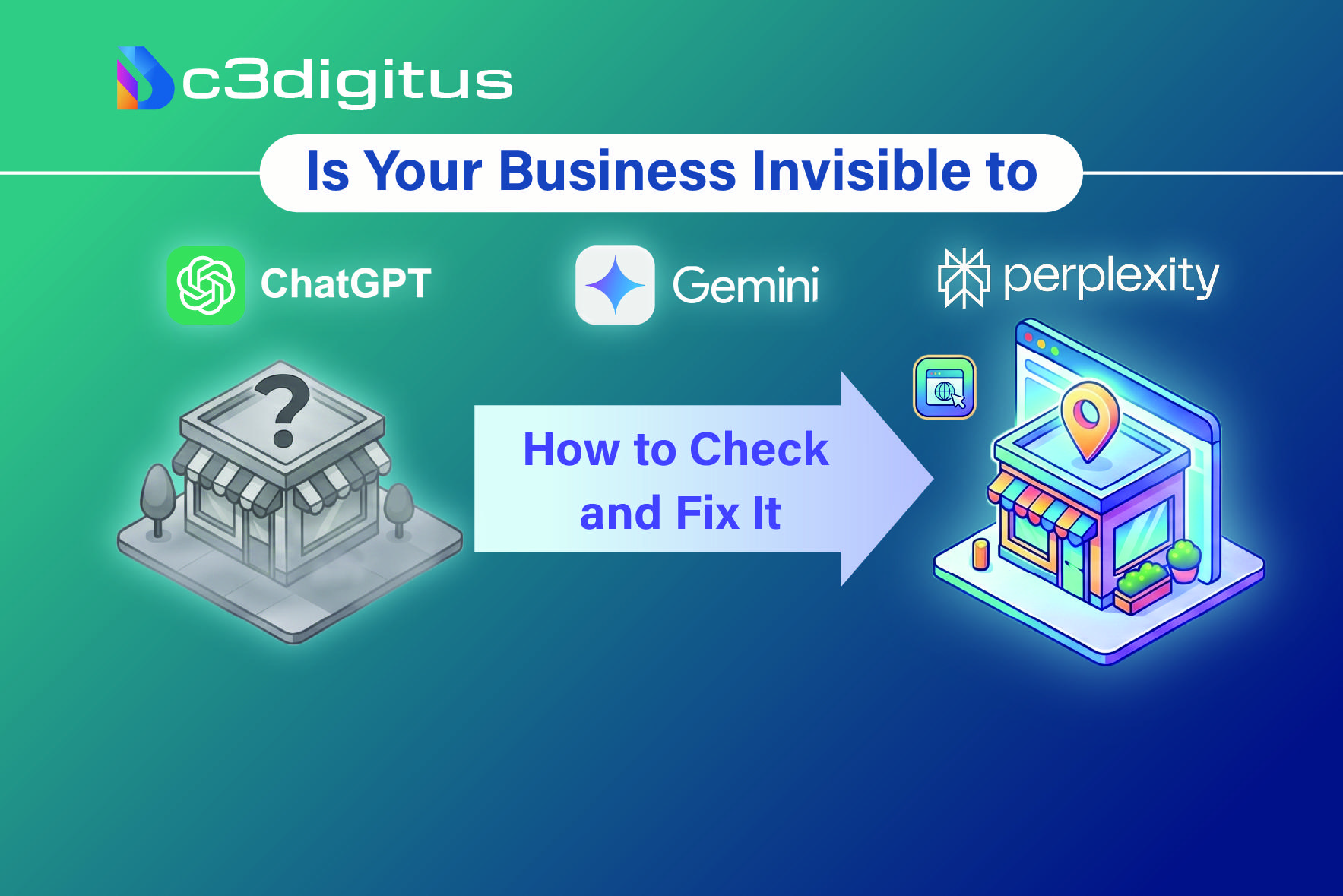
Most businesses now show up on Google but are completely invisible to AI tools like ChatGPT, Gemini, and Perplexity. This is a fast-growing problem because more and more buyers are starting their search on these platforms, not Google. This post shows you how to check your AI visibility in 5 minutes, why you’re likely missing, and exactly what to do to fix it
Here’s a question most business owners haven’t thought to ask: “If someone asks ChatGPT, Gemini, or Perplexity to recommend a company like yours, do you show up?”
If you don’t know the answer, that’s already a problem. Because your potential customers are asking exactly that question every day, across millions of AI-powered searches.
Google is still the dominant search engine. But the search landscape has changed fast. A growing segment of buyers, especially in B2B, now start their research by asking AI assistants directly. They type things like:
- “Best digital marketing agencies for manufacturers“
- “Who offers AEO optimization services in the US?”
- “Which SEO agency understands industrial companies?”
If your business isn’t showing up in those AI-generated answers, you’re missing a real, measurable opportunity. And most businesses are completely invisible, not because they’re doing something wrong, but because AI visibility works differently from traditional SEO, and most companies haven’t caught up yet.
This post walks you through how to check your AI visibility, explains why you might be missing, and gives you a clear set of actions to fix it.
Why AI Search Visibility Matters in 2026
Search didn’t just evolve; it fragmented. Today’s buyer might Google something, then ask ChatGPT for a recommendation, then validate on Perplexity, then check reviews on Gemini. Each platform pulls information from different sources using different methods.
According to industry data, nearly one-third of the US population will use generative AI search tools in 2026, and this number is rising sharply. More importantly, AI-driven searches tend to happen at high-intent moments, when someone is actively evaluating options and close to making a decision.
The catch? AI tools don’t rank pages the way Google does. They synthesize answers from content they’ve been trained on, web sources they can access in real time, and third-party platforms they trust. If your business isn’t part of that ecosystem, you simply don’t exist in that channel.
💡 Key Insight: Being on page 1 of Google does not guarantee visibility in ChatGPT, Gemini, or Perplexity answers. These are separate channels with separate rules.
Step 1: Check Your AI Visibility Right Now (Takes 5 Minutes)
Before doing anything else, run this quick audit. Open each of the following AI platforms and search for your business using the queries below. Note exactly what comes up, and whether your business is mentioned, cited, or recommended.
On ChatGPT (chatgpt.com)
Enable web browsing if available. Then search:
- “[Your service] agency in [your city/state]”
- “Best [your service] companies for [your industry]”
- “Who is [your company name] and what do they do?”
On Gemini (gemini.google.com)
Gemini has access to Google’s index and pulls heavily from Google Business Profiles and well-structured websites. Search:
- “[Your company name] reviews”
- “[Your service] agency near [your location]”
- “What is [your company name]?”
On Perplexity (perplexity.ai)
Perplexity is particularly important for B2B buyers because it cites sources and works like a research tool. Search:
- “Top [your service] agencies for [your industry]”
- “[Your company name], what do they specialize in?”
- “How do I find a good [your service] provider?”
Document what you find. Are you mentioned? Are competitors mentioned instead? Does the AI give a confident answer about your company, or does it say it doesn’t have enough information?
📊 What to Look For, Mentioned by name with an accurate description: you have some AI visibility. Competitor mentioned but not you: you have a gap that can be fixed. AI says it doesn’t know your company: you have no AI presence yet.
Step 2: Understand Why You’re Invisible
AI tools don’t randomly choose which businesses to recommend. They follow patterns. Here are the most common reasons a business doesn’t show up:
1. Your website content doesn’t answer questions directly
AI engines are specifically looking for content that directly answers questions, short, clear, declarative sentences. If your website is full of vague marketing language like “we deliver results-driven solutions,” AI has nothing concrete to extract and cite. It needs answers in the format: “[Company] does [X] for [Y audience] in [Z location].”
2. You have no presence on the platforms AI trusts
ChatGPT, Gemini, and Perplexity pull data from sources they consider authoritative, platforms like Clutch, G2, Crunchbase, LinkedIn, and Google Business Profile. If your business isn’t listed and reviewed on these platforms, AI has no independent signal to trust your existence.
3. No structured data on your website
Schema markup, specifically Organization, LocalBusiness, Service, and FAQPage schemas, helps AI systems understand exactly what your business does, who it serves, and where it operates. Without it, AI is guessing. With it, AI can pull precise, structured information directly from your site.
4. You haven’t built topical authority
AI models are trained to surface authoritative sources on a given topic. If you haven’t published consistent, in-depth content around your core services, AI doesn’t recognize you as a subject-matter expert, even if you are one in reality.
5. No one is citing you across the web
When publications, blogs, directories, and other websites mention and link to your business, AI engines treat that as an authority signal. A business that only exists on its own website is like a business with no word-of-mouth, invisible to the systems that reward reputation.
Step 3: Fix It: What to Do This Month
You don’t need to overhaul everything at once. These are the highest-impact actions, roughly in priority order:
Fix 1: Rewrite your homepage and service page copy in Q&A format
Add a clear FAQ section to every key page. Write answers in 40–60 words. Use direct, declarative language.
Example, Before: “We provide comprehensive digital marketing solutions tailored to your unique needs.”
After (AEO-ready): “c3digitus is a digital marketing agency specializing in SEO, AEO, and content marketing for industrial and manufacturing companies. We serve clients across the US from our base in Beaver, Pennsylvania.”
Fix 2: Add schema markup to your website
At a minimum, implement these four schema types:
- Organization schema, your name, logo, address, founding date, social profiles
- LocalBusiness schema, your service area, coordinates, hours
- Service schema, on each service page, describes what you offer and who it’s for
- FAQPage schema, wrapping your FAQ sections so AI can extract Q&A pairs directly
If you’re on WordPress, plugins like Rank Math or Yoast SEO Premium handle most of this without coding.
Fix 3: Create or optimize your third-party profiles
These platforms are heavily referenced by AI tools when generating business recommendations:
- Google Business Profile, fill every field, add photos, collect reviews
- Clutch.co, create a free profile and request reviews from past clients (Clutch is one of the most AI-cited agency directories)
- Crunchbase, add your company with a clear description of services and industries served
- LinkedIn Company Page, keep it updated; Gemini pulls from LinkedIn heavily for B2B businesses
- G2 or UpCity, relevant for service businesses
Fix 4: Publish content that AI engines want to cite
AI tools favor content that is:
- Specific and factual, includes data, stats, concrete examples
- Structured, uses clear H2/H3 headings, bullet points, and short paragraphs
- Authoritative, includes author bios with credentials, links to trusted sources
- Fresh, published, or updated recently (AI tools often filter for recent content)
One well-structured, 1,500-word guide on a topic you genuinely know well is worth more for AI visibility than ten thin, generic posts.
Fix 5: Track your AI visibility monthly
Unlike Google rankings, which you can track automatically, AI visibility currently requires manual checking. Set aside 30 minutes each month to run the audit queries from Step 1 again. Note which platforms mention you, which competitors appear instead, and whether your description is accurate when you are cited.
Over time, you’ll see your mentions grow as you implement these fixes, and you’ll spot gaps to address before competitors do.
How Long Does It Take to Show Up in AI Search?
This is the most common question, and the honest answer is: it varies, but you can see early results faster than traditional SEO. Here’s a rough timeline based on what we’ve seen:
Week 1–2: After adding schema and updating third-party profiles, Gemini, which pulls live from Google, can reflect changes quickly, sometimes within days.
Month 1–2: Perplexity starts citing pages that have clear, structured answers. Your Clutch and Crunchbase profiles become visible in business-related queries.
Months 3–6: ChatGPT (especially with browsing enabled) begins to surface your business for relevant queries as your content authority builds.
Month 6+: Consistent AI mentions across all platforms as topical authority compounds. Your brand starts appearing unprompted in category-level queries.
Frequently Asked Questions
What is AI search visibility?
AI search visibility refers to how prominently a business appears in responses generated by AI-powered tools like ChatGPT, Google Gemini, Perplexity, and Microsoft Copilot. Unlike traditional search rankings, AI visibility is determined by how well your content, structure, and third-party presence signal authority and relevance to AI systems.
Is AI search visibility the same as SEO?
No, but they overlap significantly. Traditional SEO focuses on ranking pages in Google search results for human clicks. AI search visibility (often called AEO or GEO) focuses on being cited and recommended inside AI-generated answers. Good SEO forms the foundation for AI visibility, but additional steps, such as structured data, FAQ formatting, and third-party citations, are also required.
Which AI tools should I prioritize for visibility?
In 2026, the three most important AI search platforms for business visibility are ChatGPT (including ChatGPT Search), Google Gemini (which is integrated into Google Search via AI Overviews), and Perplexity. Microsoft Copilot is also growing in B2B environments. You should aim to appear in all of them, as different audiences use different tools.
Can small businesses appear in AI search results?
Yes. AI tools don't automatically favor large brands. They favor authoritative, well-structured content and businesses with consistent, accurate information across the web. A small agency or local business with strong third-party profiles, clear FAQ content, and proper schema markup can outrank large competitors in AI-generated answers.
How do I know if a fix is working?
Run the 5-minute audit from Step 1 of this article monthly. Track whether your business appears more frequently, whether AI descriptions of your company are accurate, and whether you're being cited for relevant service queries. Over time, also watch for referral traffic from AI platforms in your Google Analytics.
Want to check your AI visibility?
c3digitus offers a free SEO and AI visibility report for businesses that want to understand where they stand. We’ll show you exactly what ChatGPT, Gemini, and Perplexity see when someone searches for your business, and give you a clear action plan to improve it.
The Bottom Line
Most businesses spent the last decade learning how to get found on Google. The next challenge is learning how to get found by AI, and the businesses that start now will have a significant advantage over those that wait.
The good news: the steps are practical, the timeline is shorter than traditional SEO, and the tools available today make it genuinely achievable for businesses of any size.
Start with the 5-minute audit above. See where you stand. Then take the first step, because if you’re not in the answer, your competitor will be.