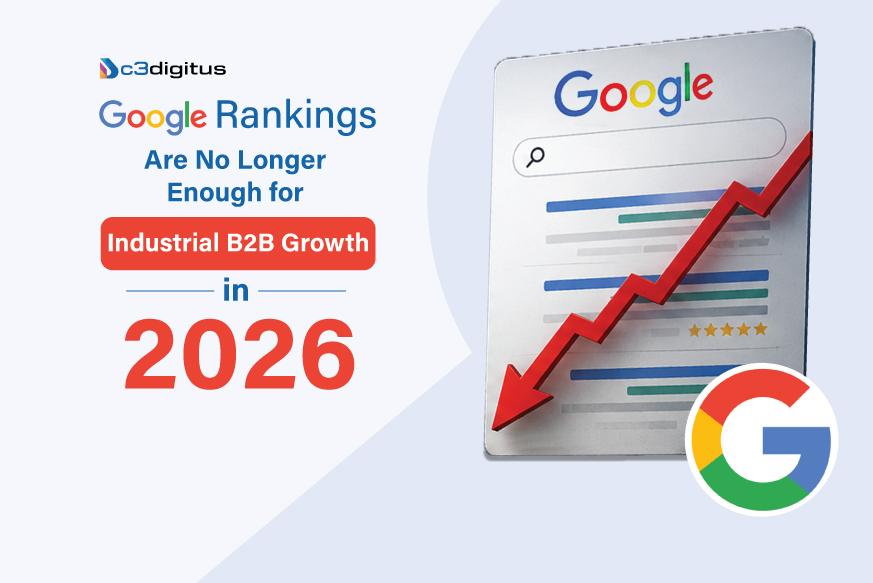
Why “Omnipresent Visibility” — not a single search ranking — is the real competitive edge for manufacturers and industrial suppliers in 2026.
What You Will Learn in This Article
- Why Google-only SEO is leaving high-value contracts on the table in 2026
- The 4 new “Front Doors” industrial buyers use to find and vet suppliers
- How Generative Engine Optimization (GEO) works — and how to win at it
- The 3-pillar Omnipresent Visibility strategy for manufacturing brands
- Which metrics actually predict RFQs and signed contracts (hint: not page views)
1. The Death of the “Blue Link” Monopoly
Do you still believe ranking #1 on Google is the holy grail for your manufacturing business? Here is the uncomfortable truth: being at the top of Google in 2026 could mean you are missing more than 70% of the high-value contracts your competitors are quietly winning elsewhere.
For over a decade, the playbook for an industrial digital marketing agency was simple: win at Google, win at business. If you were not on Page 1 for “custom metal stamping,” you were invisible. That wall has crumbled.
Procurement officers and engineers no longer just “Google” their problems. They ask AI agents to shortlist ISO-certified vendors, vet reliability on industry-specific forums, and watch technical teardowns on YouTube to confirm your equipment actually holds up in production.
If you are an industrial B2B marketing agency still building a Google-first strategy, you are optimizing for a shrinking share of a much larger conversation. Visibility — the new currency — means showing up wherever decision-makers are looking, even when they never click a link to your website.
Key Concept: AEO vs. Traditional SEO
Traditional SEO = optimizing for a search engine algorithm.
AEO (AI Engine Optimization) = structuring your content so AI models cite you as the authoritative source.
In 2026, industrial brands need BOTH — and most only have one.
To understand how the underlying metrics have shifted, read our in-depth guide: Website Analytics in 2026: The GA4, GTM, GSC & GMB Guide That Actually Helps You Grow.
2. The Fragmentation of Search: The 4 New “Front Doors”
The “search bar” is no longer a single white box at Google.com. For a marketing agency for manufacturing industry leaders, understanding where buyers actually begin their vendor research is mission-critical. Here are the four primary entry points.
Door 1 — Technical Validation (Reddit & Industry Forums)
Engineers trust engineers — not ads. Before a procurement team signs a contract for a new CNC line or a chemical supply chain, they go to Reddit, Eng-Tips, and niche manufacturing communities looking for real-world evidence: Does this machine actually hold those tolerances? Is their support team responsive during downtime? If your brand is absent from these dark-social corners, you are losing the trust battle before the sales conversation even begins.
Door 2 — Vertical Search (Thomasnet, GlobalSpec, Engineering360)
For a large segment of B2B buyers, search begins and ends on specialized portals. Sites like Thomasnet, GlobalSpec, and Engineering360 function as the “Google” of the industrial world. Buyers arrive here with high purchase intent — ready to request an RFQ right now. If your technical specifications, certifications, and capabilities are not indexed here, you are invisible to this entire audience segment.
Door 3 — AI Specialist Queries (Perplexity, ChatGPT, Gemini)
High-level decision-makers increasingly use AI to build vendor shortlists. Instead of hours of Google research, they prompt: “Find me three ISO 13485 certified contract manufacturers in the Northeast with cleanroom capabilities.” If your technical data is not structured for AI extraction, your name will not appear — regardless of your Google ranking.
This is the essence of AEO (AI Engine Optimization). For a full breakdown of how Google’s own AI evaluates your content quality, read: Does Google Penalize AI-Generated Content? The Definitive SEO Guide.
Door 4 — LinkedIn as a B2B Discovery Engine
LinkedIn in 2026 is not a resume platform. It is the primary B2B discovery feed where potential clients first encounter your case studies, plant expansions, and technical innovations — forming a first impression months before they are ready to issue an RFQ.
Our Social Media services for industrial brands are built specifically around this reality. See also: Short-Form vs Long-Form Videos: Which Is Better for Your Business? for guidance on what video content performs best in the industrial LinkedIn feed.
Discover Where Your Industrial Brand Has Visibility Gaps
Not sure which of these four doors your ideal buyers are actually using? Our free SEO report pinpoints your exact gaps — before your competitors fill them.
Our SEO and AEO (AI Engine Optimization) Services are specifically designed to make sure you are the top-of-mind choice, no matter which door the buyer walks through.
3. From SEO to GEO: Generative Engine Optimization Explained
When an engineer asks an AI engine, “What is the most durable coating for high-heat turbine components?”, they are not looking for a list of websites. They want a trustworthy answer they can act on. This is where Generative Engine Optimization (GEO) becomes the decisive competitive advantage.
Moving Beyond Keywords to “Topical Nodes”
AI does not simply match keywords. It maps the relationship between your brand and adjacent concepts like tolerances, ISO 9001 certification, material versatility, and lead-time reliability. To appear in an AI’s response, your content must be so technically dense and consistently published that the model views you as the primary source of truth for the entire topic.
The Citation Economy
AI engines cite their sources. If an AI provides a precise technical answer without referencing your whitepaper or case study, you have lost the session. Winning at GEO requires structuring your data with proper Schema markup so AI bots can extract your specifications and present them as the definitive answer.
Sentiment & Verified Experience
Industrial buyers are risk-averse — and AI mirrors that caution. It scrapes trade journals, PDF catalogs, and industry news to gauge brand reputation before recommending a vendor. If you partner with a specialized industrial digital marketing agency, their core job is ensuring the sentiment surrounding your brand across the entire web communicates reliability and precision.
E-E-A-T: The Foundation of AI Recommendations
Google’s E-E-A-T framework — Experience, Expertise, Authoritativeness, and Trust — has become the baseline for AI recommendations, not just search rankings. Generic content is ignored. Content that includes real-world test data, engineer-led insights, and documented case studies is prioritized by both human readers and AI models.
GEO Readiness Checklist
☐ Is your site content structured with Schema markup for AI parsing?
☐ Do your pages include specific technical claims with real data (tolerances, certifications, capacity)?
☐ Is your brand cited in industry trade journals, press releases, or third-party directories?
☐ Do your content authors have attributed credentials (engineer name, title, certifications)?
☐ Are your whitepapers and spec sheets publicly accessible for AI crawlers?
To understand how Google’s February 2026 Core Update and Google’s March 2026 Spam Update are reshaping the rules for industrial content.
4. The “Omnipresent Visibility” Strategy for Industrial B2B
In manufacturing, visibility is not about fame. It is about being inescapable during the research phase when engineers and procurement managers are trying to minimize supply chain risk. They are not just looking for a vendor — they need a partner who will not break their production line.
A specialized industrial digital marketing agency builds that presence through three specific pillars.
Pillar 1 — Technical Dominance on Niche Platforms
Your buyers are in the weeds. They are on Thomasnet, Engineering360, and specialized LinkedIn groups for supply chain management. Visibility means having your technical specs, CAD files, and whitepapers indexed and ready exactly where they conduct deep-dive research.
Our Content Marketing strategies for industrial brands are built to distribute your technical authority across all the platforms where buyers actually make purchase decisions.
Pillar 2 — Thought Leadership as a Competitive Moat
In B2B, visibility is inseparable from authority. You should not just communicate what you make — you need to articulate how you solve the industry’s most painful problems: navigating raw material shortages, implementing Industry 4.0, reducing machining lead times. On LinkedIn or in a trade publication, that answer transforms you from a commodity vendor into a visible expert.
Video is increasingly central to this pillar. See our analysis: Short-Form vs Long-Form Videos: Which Works Better for Your Business?, and explore our Video Production services for industrial brands.
Pillar 3 — Account-Based Visibility (ABV)
A modern marketing agency for the manufacturing industry does not chase broad traffic. It engineers Account-Based Visibility (ABV): IP-targeted content that ensures when a lead at a Tier 1 automotive supplier is browsing the web, they see your case studies, certifications, and plant expansion news across multiple touchpoints over time.
Our Lead Generation services are architected around ABV, not spray-and-pray traffic acquisition. For paid amplification of ABV, see our Digital Advertising services.
Ready to Build Omnipresent Visibility for Your Brand?
We engineer visibility across search, AI engines, industry portals, and LinkedIn — so you are the “inescapable” choice when a buyer is ready to shortlist suppliers.
→ Book Your Free Strategy Call →
Free 30-minute session. No pitch — just a clear picture of your current visibility gaps.
5. Rethinking Your Metrics: Why “Traffic” Does Not Equal “High-Value Leads”
If you are a CEO or Sales Director in manufacturing, you do not care about viral posts or monthly page view reports. You care about the RFQ (Request for Quote). And in 2026, the metrics that actually predict RFQs look nothing like the dashboards most agencies are still building.
Metric 1 — Share of Model (SoM): Your AI Reputation Score
We used to track “Share of Search” — how many people Googled your brand. The new equivalent is Share of Model (SoM): when a procurement officer asks an AI, “Which US-based fastener suppliers have the highest capacity for aerospace-grade titanium?” — does your name appear in the response? If LLMs are not citing your brand, your effective visibility is zero — regardless of your Google position.
Metric 2 — Intent-Based Account Reach
Visibility is measured by who sees you, not how many. Are your technical spec sheets being downloaded by engineers from your target account list? Is a procurement manager from a major OEM spending 20 minutes on your tension-strength data page? One qualified session from the right person outweighs 10,000 random visitors.
Metric 3 — Assisted Conversion Pathing
B2B industrial sales cycles are marathons. Visibility means staying top-of-mind from the moment an engineer identifies a problem to the moment procurement issues the purchase order — a journey that often spans 6 to 18 months.
- The old way: Tracking the last click before they filled out a contact form.
- The new way: Mapping the “invisible journey” — how they saw your technical webinar, read your Reddit answer, reviewed your LinkedIn case study, and checked your Thomasnet listing before finally reaching out.
Are You Measuring the Right Things?
Most industrial marketing reports still lead with traffic and impressions. We report on Share of Model, account-based reach, and assisted conversion paths — the metrics that actually predict revenue.
Or talk to us directly about your current reporting setup.
6. Conclusion: Be Adaptive or Become Obsolete
The message is unambiguous: the Google-only strategy is a relic of 2015.
For the modern industrial digital marketing agency, the challenge is not simply getting a website to rank. It is building a digital footprint so strong and so wide that your brand becomes the “default” answer — wherever a buyer looks, whatever tool they use to search.
Whether it is an AI agent summarizing your capabilities, a peer recommendation on a technical forum, a high-value spec sheet on an industry portal, or a LinkedIn post that lands in the feed of the right VP of Procurement — visibility is the new currency of industrial B2B.
If you continue playing the 2015 SEO game, your leads will dry up as buyers migrate to platforms where you are simply not present. But if you embrace Omnipresent Visibility, you will not just survive the fragmentation of the internet — you will dominate your niche within it.
Your Next Step
Do not wait for your competitors to claim the AI real estate in your category. You need a strategy that covers the full buyer journey — from first discovery to the final signed RFQ.
At c3digitus, we specialize in serving manufacturing industry leaders who are ready to move beyond the blue link. We do not just “do SEO” — we engineer visibility across every channel that matters to your buyers.
Your Competitors Are Already Claiming AI Visibility. Are You?
The industrial brands that act now will own the AI-recommended shortlists for the next 5 years. The ones that wait will be invisible — even to buyers actively searching for exactly what they offer.
→ Book Your Free Intro Call Now →
Or explore our full Learning Center for more industrial marketing insights.
Frequently Asked Questions
1. We have been in business 30 years without digital marketing. Why start now?
Your legacy is your strongest asset, but your future buyers are not using the old boys' network. Millennials and Gen Z now make up the majority of B2B buying committees. If you are not visible where they research — AI engines, LinkedIn, industry forums — you do not exist to the next generation of procurement officers.
2. Does SEO even work for a niche manufacturing business?
Yes — but not the high-volume SEO you are used to. You do not need 10,000 random visitors. You need the 50 engineers searching for your exact tolerance capabilities and lead-time guarantees. Narrow, technical SEO combined with AEO (AI Engine Optimization) is how you win high-value contracts. For the full SEO landscape in 2026, read: How to Protect Your SEO During a Website Redesign.
3. Is Google really losing its power in B2B?
Google is still essential, but no longer the only front door. Buyers now vet suppliers through AI (ChatGPT, Perplexity), Reddit threads, and niche portals before they ever click a Google result. See: Google's March 2026 Spam Update: What Changed and Google's February 2026 Core Update.
4. How do we get AI like ChatGPT to recommend our brand?
This is the core of GEO (Generative Engine Optimization). AI recommends brands with high topical authority and consistent mentions across the web. You need your technical data structured for AI extraction and your brand cited in authoritative trade journals and industry directories. Deep dive: Does Google Penalize AI-Generated Content?.
5. Should our manufacturing plant be on social media?
Not for likes — for visibility and credibility. LinkedIn is the modern trade show. A 30-second video of a machine running a complex part proves your capability more effectively than a 10-page brochure. Video strategy guides: Short-Form vs Long-Form Videos and What Is Video Marketing?.
6. Why am I getting website traffic but no RFQs?
Classic intent mismatch. You are likely ranking for informational keywords rather than commercial ones. Or your site lacks the technical documentation — CAD files, spec sheets, tolerance data — that a B2B buyer needs to move to the next step. Analytics fix: Website Analytics in 2026.
7. How long before we see ROI from a digital strategy?
B2B sales cycles are long. Increased visibility typically materializes within 3 months; actual signed contracts usually align with your sales cycle — 6 to 12 months. The goal is to fill the top of the funnel now so you are not starving for leads next year.
8. Is AI-generated content going to hurt our rankings?
Only if it is generic and low-value. Google and AI engines prioritize E-E-A-T. Our content is led by your engineers’ real-world insights, not a bot’s guesswork. Full breakdown: Does Google Penalize AI-Generated Content?.
9. What are the most important metrics to track in 2026?
Track: (1) Share of Model — how often AI cites your brand in relevant queries; (2) Account-Based Reach — are engineers from your target companies visiting your technical pages?; and (3) Assisted Conversions — how many touchpoints occurred before the phone rang? Full setup: Website Analytics in 2026.
10. Why hire a specialized industrial agency instead of a general firm?
A general agency pitches viral content and vanity metrics. An industrial B2B marketing agency understands ISO certifications, material grades, lead times, and the difference between cold-rolled and hot-rolled finishes. We speak your language from day one. Compare options: Top 10 Digital Marketing Agencies in the USA for 2026.
Related Articles from the c3digitus Learning Center
- Website Analytics in 2026: The GA4, GTM, GSC & GMB Guide That Actually Helps You Grow
- Does Google Penalize AI-Generated Content? The Definitive SEO Guide
- Google’s February 2026 Core Update: What Manufacturers Need to Know
- Google’s First Spam Update of March 2026: What Changed
- How to Protect Your SEO During a Website Redesign in 2026
- Top 10 Digital Marketing Agencies in the USA for 2026
- Short-Form vs Long-Form Videos: Which Is Better for Your Business?
- Paradox of Perfection: AI Can Create, But Can It Connect?
- WordPress 7.0 & WordCamp Asia 2026: What It Means for Your Site