
Quick summary
Who this is for: Marketing leaders and SEO owners at manufacturers and industrial suppliers.
The short answer: Find who actually ranks for your priority topics, compare their pages with yours, remove searches that do not fit your buyers, and map each remaining gap to one page decision.
What you need: Search Console data, a keyword research tool, your product and capability priorities, and an hour with sales.
How to judge it: Visibility for priority searches and suitable inquiries from the pages you change, not the size of the keyword list.
Competitor keyword analysis compares the searches where competing websites appear with the searches where yours does, then decides which gaps are worth closing. For a manufacturer, the useful result is not a long keyword export. It is a short list of page decisions: improve this capability page, build that application page, and leave those keywords alone.
The method below is written for manufacturers, industrial suppliers, and other technical B2B companies whose buyers include engineers, procurement teams, and distributors. Work through it one product line or capability at a time, rather than across your whole catalog at once.
Who Your Search Competitors Actually Are
Your search competitors are whoever appears for the searches your buyers make. That list overlaps with the companies sales competes against, but it is rarely the same. A distributor may outrank you for your own product category, and a trade publication may own the questions engineers ask before they contact any supplier.
Sort what you find into types before you analyze anything, because each type teaches something different.
| Competitor Type | Why It Ranks | What To Learn From It | Compete Directly? |
|---|---|---|---|
| Direct competitors | Similar products for the same buyers | Product, capability, and application coverage; how specifications and inquiry routes are presented | Yes, where buyers and markets overlap |
| Distributors and online catalogs | Broad catalogs, part numbers, many inbound links | Which part, specification, and category searches buyers use | Rarely. Many are channel partners, so build what they cannot, such as application and engineering detail |
| Supplier directories and marketplaces | Pages that aggregate many suppliers | Which categories buyers browse when shortlisting | No. Decide separately whether a listing is worth having |
| Publishers, associations, and standards bodies | Authoritative explanations of technical topics | The questions buyers ask before choosing a supplier | Only where your team has real expertise to add |
| Unrelated businesses using the same words | The same term means something else to most searchers | Which terms are ambiguous and need qualifiers | No. Exclude these searches |
What To Gather Before You Start
The analysis is only as good as the business priorities behind it. Collect these inputs first:
- Your own Search Console data. Export the queries and pages for the product line you are studying, filtered to the countries you sell into. Google notes that anonymized queries are left out of the query table and that filters change the totals, so treat the export as a strong sample rather than a complete list.
- A priority list from leadership and sales. Name the products, capabilities, applications, industries, order sizes, and regions you want more of, and the ones you do not.
- Sales and customer service input. Ask which questions buyers raise before quoting, why recent deals were lost, and which competitors buyers mention.
- A keyword research tool. You need one to see which searches competitor pages rank for and to estimate demand.
- Paid search data, if you run ads. Google’s search terms report shows the actual searches that triggered your ads, which is useful evidence of how buyers phrase their needs.
Step 1: Start With The Topics That Earn Revenue
Begin with your own priorities, not a competitor’s keyword list. Take the product families, capabilities, applications, and industries from your priority list, and write the searches a buyer would use for each. Include specification terms, standards, materials, and problem descriptions, such as a rating requirement or a failure the buyer wants to prevent.
The queries your pages already appear for in Search Console show how buyers describe your products, including terms you never chose. A few dozen seed searches per product line is enough to start.
Step 2: Find Out Who Ranks For Those Searches
Search your most important seed terms from the region you sell into. Record who appears, what type of page ranks, and what sits above the organic results, such as ads, an AI Overview, or product listings. Then use your keyword tool’s domain comparison report to see which sites overlap with yours across many searches.
Keep the three to five sites that appear most often for your priority terms and actually serve your buyers. For your most important questions, also note which sources AI Overviews cite. Google says its generative AI features are built on its core ranking and quality systems, so the cited pages are usually ones that already perform well in search.
Step 3: Compare Queries And Landing Pages
For each competitor, export the searches it ranks for and the page that ranks for each, then compare them with your own rankings. Most tools sort the results into searches you share, searches only the competitor ranks for, and searches where you rank lower.
The landing page matters more than the keyword. A competitor ranking with a detailed application page tells you something different from one ranking with a homepage or a thin category page. Group keywords by the page that ranks, so you compare pages rather than isolated phrases.
Step 4: Read The Search Intent On The Results Page
Before you treat a gap as an opportunity, look at what Google shows for it now. The results reveal what searchers expect:
- Product and category pages suggest buyers are ready to compare suppliers.
- Guides and explainers suggest research before a supplier decision.
- Distributor listings and part-number pages suggest replacement buying of a known item.
- Videos and forum threads suggest a practical how-to or troubleshooting question.
If every result is a guide and you planned a product page, the product page is unlikely to rank for that search. Match the page type to the intent, or choose a different search.
Step 5: Remove Opportunities You Should Not Pursue
A keyword gap is not automatically an opportunity. Remove searches that would bring visitors you cannot serve:
- Jobs, training, and certification searches related to your process.
- Consumer and DIY searches for products you only sell to industry.
- Products, materials, sizes, or order volumes you do not supply.
- Regions you do not ship to or support.
- Competitor brand names, unless you have a genuine comparison or replacement page that helps the searcher.
- Broad definitions with no realistic path to an inquiry, unless sales confirms buyers need that explanation first.
Record what you excluded and why. The next review will not have to re-evaluate the same terms, and your paid search team can use the list for negative keywords.
Step 6: Build A Competitor Gap Matrix
A gap matrix, sometimes called a competitor keyword matrix, turns the remaining searches into decisions. Use one row per search group, not per keyword variation. Each row answers six questions: what was searched, what the buyer needed, which page currently serves that need, what your site is missing, what you will do, and why it matters commercially.
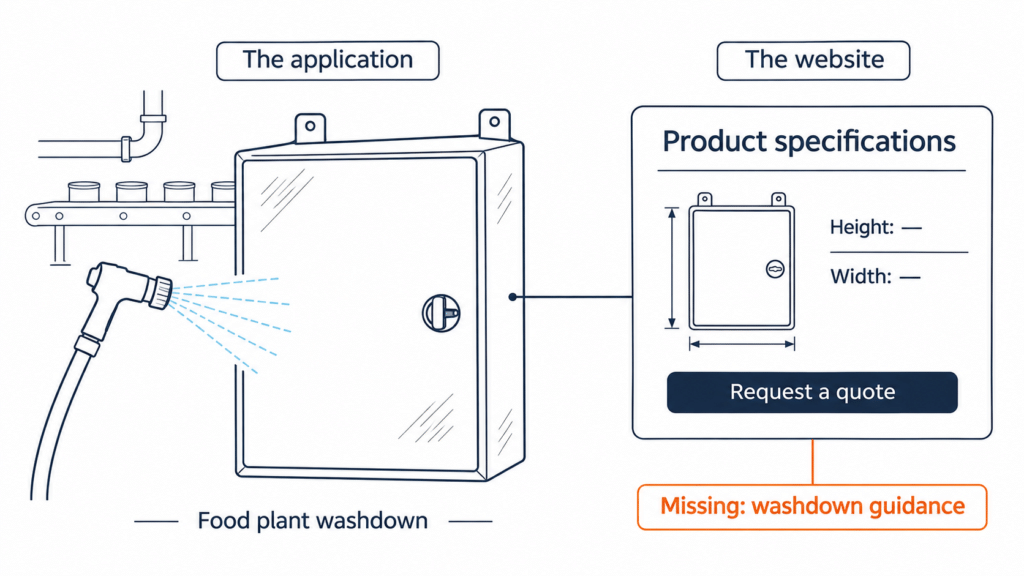
The “what is missing” column is the most important. It forces you to compare information, not word counts. A competitor page often wins because it answers a question yours does not, such as which material suits a cleaning process or what a buyer needs to send for a quote.
| Search | Buyer Need | Page That Currently Wins | Missing From Your Site | Action | Commercial Rationale |
|---|---|---|---|---|---|
| washdown enclosure food processing | A plant engineer needs an enclosure that survives daily sanitation | A direct competitor’s application page covering cleaning conditions, materials, and design details | No application page; washdown details scattered across product pages | Build a food and beverage washdown application page that links to the relevant product families | Core market with high order values, and sales confirms frequent requests |
| NEMA 4X vs IP66 | An engineer is comparing rating systems before specifying | A standards publisher’s explainer and a distributor’s comparison guide | Product pages list ratings without explaining what they mean for the buyer | Add a short ratings explanation to the product family page and cite an authoritative source | Supports specification, but publishers already answer the general question well |
| stainless enclosure 304 vs 316 | A buyer is choosing a material grade for harsh cleaning chemicals | A competitor article with a material comparison table | Both grades are offered, with no guidance on choosing | Add an engineering-reviewed material selection section to the product family page | Reduces quoting back-and-forth and wrong-material requests |
| custom stainless enclosure lead time | Procurement is checking whether a supplier can meet a schedule | A competitor capability page explaining its custom process | The quote form asks for drawings but explains nothing about the process | Improve the capabilities page: process steps, information needed for a quote, typical scope | Directly improves RFQ quality |
| electrical enclosure for home, enclosure jobs | A homeowner or a job seeker | Retailers and job boards | Not applicable | No action; add to the exclusion list | Not the company’s buyers |
Notice the shape of the result. Four rows lead to work, but only one creates a new page. The others improve pages that already exist, and one search is deliberately excluded. A matrix that recommends a new page for every row usually means the existing pages were never compared.
Step 7: Map Each Opportunity To One Page
Every row that survives needs exactly one destination. There are four options:
- Improve an existing page when it already covers the topic but lacks the information buyers need. This is the most common outcome.
- Create a new page when nothing on your site serves the need and the results show it requires a distinct page type, such as an application page.
- Consolidate when two of your pages compete for the same need. Combine them and redirect the weaker URL.
- Take no action when the gap is real but not worth the effort now.
Resist building a separate page for every keyword variation. Google’s guidance on AI search warns that creating content for every possible variation of a query to manipulate rankings breaks its spam policies and does not make a site more relevant. One strong page per buyer need works better. Our on-page SEO guide for B2B companies and manufacturers covers how to improve the page itself.
Give each destination a clear next step, such as a specification download or a quote request. If the competitor pages that win are better connected to an inquiry route, that is part of the gap too.
Step 8: Prioritize, Then Review On A Schedule
Score each action on five factors. A simple score from one to three for each is enough; sort by the total and start with the top few.
| Factor | The Question To Ask |
|---|---|
| Buyer fit | Would the people searching this become customers you want? |
| Commercial value | Does it lead to products or services with healthy margins or order values? |
| Capacity | Can you deliver more of this work, and can engineering review the content? |
| Sales need | Does sales hear this question, or lose deals over it? |
| Ability to compete | Can your page realistically match the depth and authority of the pages that win? |
For the last factor, look at who wins, not only at a tool’s difficulty score. Our guide to keyword difficulty explains why those scores are estimates.
Record the date of every change. In Search Console, use a regex query filter to track the target search group for each changed page, and in analytics, track inquiries that began on that page. Check that changes are indexed within a few weeks, then compare equivalent periods once enough data has built up. How long SEO takes to show results depends on the change and your starting point. Revisit the competitor picture quarterly, rather than reacting to every ranking movement.
Where Paid Search Fits
Keep paid and organic decisions separate. The organic analysis decides which pages to build or improve. Paid search decides where to buy visibility, either while those pages earn rankings or where organic results are unrealistic.
The two still inform each other. Paid search terms show how real buyers phrase their needs and which searches produced qualified inquiries, which is strong evidence for prioritizing a matrix row. That does not mean bidding on every gap or on competitor brand names; judge paid terms by cost per qualified inquiry. For the paid side, see our beginner’s guide to Google Ads for B2B companies.
Mistakes To Avoid
- Copying a competitor’s keyword list. Their products, markets, and priorities differ from yours.
- Chasing volume. A low-volume specification search from an engineer can be worth more than a broad term that students use.
- Treating tool estimates as facts. Use them to compare options, and confirm with your own data.
- Comparing word counts instead of information. Google states there is no ideal page length. Length helps only when it adds something buyers need.
- Reaching for technical shortcuts instead of better pages. Google says structured data is not required to appear in its AI features, and FAQ rich results no longer appear in Google Search. Markup cannot replace missing information.
- Analyzing without assigning work. A matrix with no owners or dates is research, not a plan.
Want a competitor search analysis for your product lines?
c3digitus runs competitor search analysis for manufacturers and industrial suppliers. We identify who ranks for your priority products and applications, build the gap matrix, and recommend which pages to improve, create, consolidate, or leave alone.
It suits marketing teams that can see competitors are more visible, but cannot yet tell which gaps matter commercially.
Useful to bring
- Your priority product lines and markets
- The two or three competitors sales mentions most
- Search Console access or a recent export
Book an intro call | See our SEO and search visibility services