
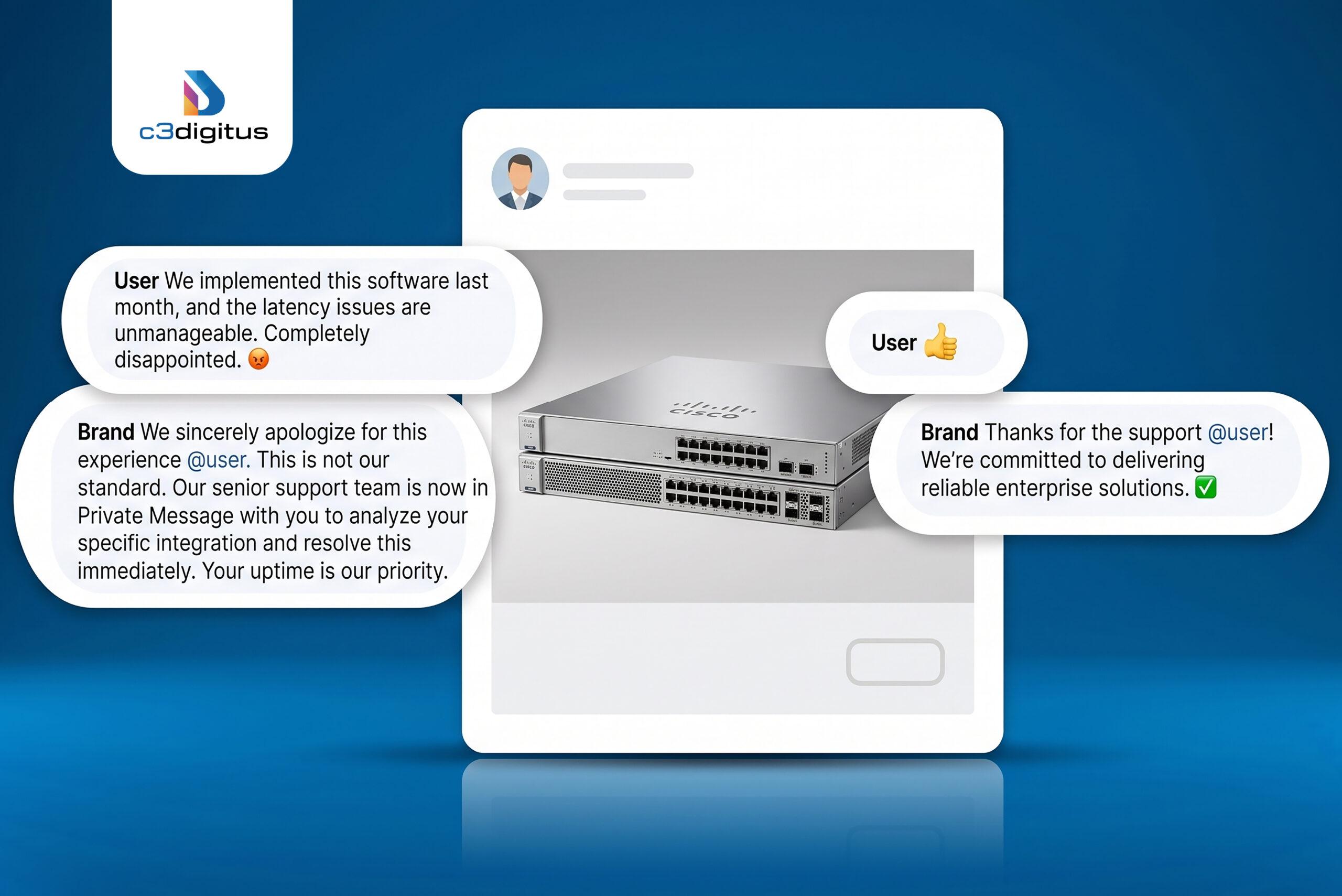
What makes negative comments different in B2B
A complaint about an industrial order may involve a manufacturer, distributor, integrator, and end customer. The person who posts may not hold the purchasing account. A missing invoice match is therefore a reason to investigate privately, not proof that the comment is fake.
Technical complaints also depend on context. Product version, application conditions, installation, maintenance, and the wording of the original claim can change the answer. A community manager should not decide those facts from a photograph or short comment.
Different buyers will notice different parts of your response. Engineering may look for documented limits. Procurement may look for clear ownership and delivery commitments. Operations may need a credible support route. Write so each can understand what is known and what happens next, without disclosing the customer’s project.
This approach connects social media customer service with an established business discipline. ISO 10002 describes complaints handling as a process that can sit within a quality management system, including analysis and improvement. Its scope excludes employment disputes, which need a separate route.
Decide whether to reply, escalate, or moderate
Assess the underlying issue before judging the language. A polite report of overheating deserves faster specialist attention than an angry comment about pricing. A small account can report a serious problem; follower count is not a reliable priority rule.
Use this decision sequence before publishing a response:
- Is there potential immediate harm, a safety concern, exposed sensitive information, fraud, or a credible threat? Notify the relevant incident owner immediately upon discovery. Follow emergency procedures where applicable. Do not wait for ordinary content approval.
- Does the comment describe an identifiable service or product problem? Capture it, open or connect a support case, and assign someone who can investigate.
- Does it challenge a public fact? Compare the exact claim with current evidence. Correct your own error if the criticism is valid; provide a proportionate factual clarification if it is not.
- Does it violate a documented conduct rule? Preserve necessary evidence, then use appropriate moderation or reporting controls. Negative sentiment alone is not a violation.
- Is it an opinion without a request or factual issue? A brief acknowledgment may be enough. Repeated arguments rarely add useful information for the reader.
Give each issue an operational owner
Issue | First useful action | Accountable owner |
|---|---|---|
Delivery or service complaint | Locate the case securely and confirm the next update | Customer service with operations or the account manager |
Performance or specification dispute | Check the product, application, document revision, and claimed limit | Technical support or engineering with quality |
Possible safety defect | Activate the established incident process | Quality or product safety with relevant specialists |
Incorrect certification or company claim | Verify scope against the current record and correct affected sources | Quality or the factual owner with communications |
Employee complaint | Preserve confidentiality and route without public personnel discussion | HR with legal review as appropriate |
Impersonation or exposed data | Preserve essential evidence and activate security procedures | Security or privacy lead |
Spam or harassment | Apply the published policy and document moderation | Community manager with security for credible threats |
Communications manages public wording. The operational owner investigates and approves the facts. Leadership should join when the issue exceeds delegated authority, crosses business units, or requires a coordinated public statement.
For a smaller manufacturer, one person may cover several roles. Name a backup anyway. A process that stops when the marketing manager is away is not ready for an urgent complaint.
Build a response process your team can actually deliver
Capture enough information to act
Record the comment URL, platform, time discovered, exact concern, affected campaign or product, assigned owner, and next update. Preserve a screenshot where necessary because a comment can be edited. Restrict access and retention according to your policies.
Use a secure support channel for account verification, purchase orders, drawings, incident records, and customer details. Direct messages can establish contact, but they should not automatically become your repository for sensitive technical or commercial information. The FTC’s business guidance on protecting personal information recommends collecting and keeping only information needed for a legitimate business purpose.
Separate acknowledgment from investigation
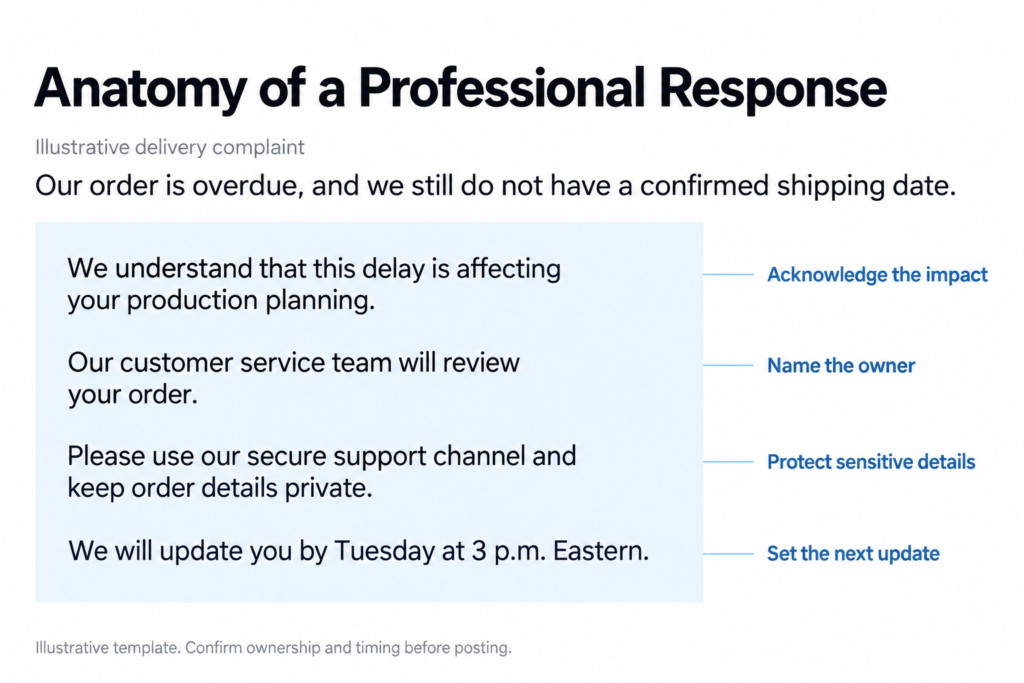
A useful first response contains four elements: the specific concern, what your team can confirm, the next action, and the next update. If you have not verified the facts, leave that part open rather than guessing.
For example, “We understand that an uncertain delivery date is affecting your planning” acknowledges the impact. “The shipment will arrive tomorrow” makes a factual promise that requires confirmation. Avoid publishing the second statement simply to make the first reply sound decisive.
Acknowledge a confirmed mistake directly. If the published lead time was wrong, explain the correction and who is handling the affected order. If fault remains unclear, describe the investigation without blaming the customer or a distribution partner.
Set realistic response targets
There is no universal response deadline suitable for every B2B company and every issue. Define targets around risk, service commitments, monitoring coverage, and specialist availability.
The following is an illustrative operating model, not an industry benchmark or a substitute for contractual and regulatory requirements.
Priority | Example | Response expectation |
|---|---|---|
Urgent | Potential harm, exposed sensitive data, credible threat | Route immediately upon discovery through the incident process |
High | Material service disruption or several related product complaints | Prompt acknowledgment and a named owner during coverage; use the agreed urgent support route where needed |
Routine | Delivery clarification or nonurgent dissatisfaction | Respond within the published service window and agree on the next update |
Nonactionable | General opinion or repetitive baiting | Assess whether one clarification helps; avoid unnecessary exchanges |
Publish monitoring hours where customers can find them. For US customers, include the time zone and any separate urgent support route. Say “We will update you by 3 p.m. Eastern on Tuesday” only when the owner has accepted that commitment.
Close the loop without overstating the outcome
Track acknowledgment, assignment, investigation, action, and closure separately. “We sent a message” is a contact attempt. “The customer confirmed receipt of the corrected shipment” is an outcome.
When appropriate, add a brief public update without revealing confidential terms: “Our service team has provided the confirmed next steps through your support case.” If no resolution is confirmed, do not label the matter resolved. If the customer stops responding, record that status accurately and leave a workable route back to support.
Response examples for manufacturers and industrial suppliers
These are hypothetical templates, not c3digitus client cases or verified campaign results. Replace bracketed fields, confirm the facts, and obtain the required approval before posting.
A distributor reports a late shipment
Comment: “Your post says dependable delivery, but our order is late and nobody can tell us when it will ship.”
Response: “We understand that the delay is affecting your planning. Please use [official support channel] and reference this comment so our service team can locate the order. [Confirmed owner or team] will provide the next update by [time and time zone]. Please keep order numbers and customer details out of this public thread.”
Behind the reply: Have customer service coordinate with operations and the channel manager. Verify whether the post describes standard availability, a particular configuration, or an outdated commitment. Correct misleading marketing copy even if the order itself is still under investigation.
An engineer challenges a product rating
Comment: “Your video makes it look as though this component is rated for every application shown. The datasheet does not say that.”
Response when the criticism is correct: “You are right that the caption does not make the application limits clear. We have corrected it. The current datasheet lists [verified rating and conditions] at [official document link]. Our technical team can review a specific application through [support channel].”
Behind the reply: Identify which models, versions, and conditions the evidence covers. Update the caption, associated landing page, and reused assets where necessary. Do not defend a broad marketing statement with a document that supports only a narrower claim.
A buyer questions a certification
Comment: “Your distributor says all locations have this certification, but I can only find a certificate for one facility.”
Response: “Thank you for flagging the discrepancy. The current certificate covers [verified scope and location], as shown at [official evidence link]. We have asked the distributor to correct the broader statement and are checking our own references.”
Behind the reply: Use this wording only after the scope and correction request are confirmed. A management system certificate for one facility does not establish certification of every product, process, or location. Record where the inaccurate claim appeared so the correction extends beyond one comment.
An operator reports a possible safety problem
Comment: “This unit overheated during operation. Has anyone else had this happen?”
Response: “We take this report seriously. Please contact [official safety or technical support channel] so the responsible team can review it. Please do not post personal details or incident documents here.”
Behind the reply: Route immediately to the safety or quality owner. Use only approved incident instructions. Do not reassure the commenter that operation is safe, diagnose the cause publicly, or let social messaging replace emergency action and any applicable reporting process.
Someone criticizes pricing without describing a fault
Comment: “Your products cost far more than the alternatives.”
Response: “Pricing depends on configuration and requirements. If you are comparing a specific application, our team can clarify what is included and which options meet it through [contact channel].”
Behind the reply: Offer verifiable comparisons when useful. Avoid unsupported claims that alternatives are unsafe or inferior. If the commenter is expressing a preference and does not want help, one respectful response is sufficient.
When to hide delete report or leave a comment visible
Leave legitimate criticism visible unless there is a separate, documented reason to moderate it. A complaint can be unfairly worded and still describe a real service failure. Evaluate the issue and the conduct separately.
Publish a short moderation policy covering threats, targeted harassment, exposed private information, impersonation, spam, and other relevant violations. Apply the same rules to praise and criticism. Preserve only the evidence you need and record the action, reason, and approver.
Platform controls do not all have the same effect:
- LinkedIn: Its Professional Community Policies address harassment, threats, personal information, and misleading content. Report relevant violations rather than treating disagreement as abuse.
- Facebook: Hiding a Page comment can leave it visible to its author and their friends. Hiding is not complete removal and may be inadequate when confidential information is exposed.
- YouTube: Comment settings allow moderation choices such as holding comments for review. Check the held queue so legitimate support requests are not overlooked.
- Google Business Profile: Reviews are a separate format. Google’s removal process is for policy violations, not simply reviews a business dislikes. Keep review handling connected to support without assuming social comment controls apply.
Do not tell the community manager to settle sensitive legal questions alone. The NLRB explains that some social media discussions about working conditions can be protected concerted activity. Route employment complaints to qualified HR or legal reviewers before deciding on moderation or an employment response.
Similarly, the FTC’s consumer review rule guidance describes prohibited review suppression practices. Its scope is not identical to every B2B social comment thread. As a practical service policy, do not condition help on deleting criticism, fabricate positive reviews, or threaten a reviewer to improve appearances.
Coordinate organic posts paid campaigns and employees
Treat comments beneath ads as part of the campaign, not an inbox someone else will eventually find. Before launch, identify who monitors comments, who has account access, and who covers complaints after the campaign manager signs off.
A specification dispute under a paid demonstration should trigger a check of the ad, video, landing page, and targeting. If a claim is inaccurate, pause or correct the affected creative. If the issue is an individual order, resolve that case while assessing whether broader messaging is misleading. Avoid automatically shutting down unrelated customer information.
For organic content, connect the community manager with the product and account teams represented in the post. Agree on the response path before publishing sensitive capability claims, new product announcements, or facility updates. This belongs in the wider B2B social media marketing strategy, alongside content planning and measurement.
Employees should know where to route a complaint and which facts are approved for public discussion. Do not organize a defensive pile on or ask employees to pose as independent customers. A salesperson can help identify an account privately without disclosing its purchasing history in the thread.
When several comments describe the same material issue, move from individual replies to coordinated incident communication. Appoint a spokesperson, maintain one approved factual update, brief service and sales teams, and review scheduled promotions for contradictions. Continue to provide useful support information while the investigation proceeds.
Correct the evidence buyers will check next
A good reply cannot repair an inaccurate product page or distributor listing. Online reputation management for manufacturers needs a source correction process that covers the places buyers use to validate a supplier.
Create a permanent website explanation when the same issue recurs, affects several customers, concerns a material public claim, or needs more detail than a comment can responsibly provide. Use the page type that fits: corrected specification, application note, certification page, support notice, location page, or approved safety notice.
Include the affected product or site, the precise correction, applicable limits, supporting evidence, responsible team, review date, and contact route. Preserve appropriate document version history. Link the relevant public response to that source so readers can check the facts themselves. These are practical trust signals consistent with the principles discussed in c3digitus’s guide to E-E-A-T.
Use a source correction log
The example below is hypothetical. “Complete” should mean the correction was checked on the published source, not merely requested.
Source and issue | Verified evidence | Owner and follow through |
|---|---|---|
Product video implies an unrestricted rating | Current datasheet with model and application limits | Product marketing corrects the caption and reused assets; engineering verifies wording |
Distributor page overstates certification scope | Current certificate and exact site scope | Channel manager requests correction and checks the live page |
Location listing routes support to a closed office | Approved address and support contact | Location owner updates the listing and tests the route |
AI answer repeats an obsolete product claim | Current product documentation and observed cited source | SEO owner checks the source, requests correction where possible, and records later observations |
For third-party sites, send a concise request containing the incorrect wording, exact URL, proposed correction, and supporting evidence. Request a factual correction without demanding removal of a legitimate opinion. This is a useful application of off-page SEO and external authority: maintaining accurate references to the business.
If a customer wishes to leave a review after support, avoid incentives and selective requests aimed only at happy customers. Google’s review guidance prohibits incentives and emphasizes genuine experiences. Resolving the issue remains the service team’s obligation regardless of whether the customer changes a review.
Monitor branded search and AI answers carefully
Check a defined set of queries such as “[brand] support,” “[brand] certification,” and “[product] application limits.” Include the relevant facility or product version when ambiguity matters. Review search results, key distributor pages, relevant forums, and a small sample of AI answers.
Record the query, date, platform, exact claim, cited source where present, and your verification result. Compare like for like checks over time. An answer without a citation does not establish where an error originated, and one changed answer does not prove that a correction fixed every system.
An AI citation strategy for industrial brands should start with accurate, accessible evidence. Google states that its AI search features require no special AI markup or additional optimization requirements. Clear public documentation can support discovery and verification, but it cannot guarantee a citation or suppress criticism.
Use AI to assist the team without inventing answers
AI can help group recurring complaints, summarize a redacted thread, or draft a response from approved facts. It should not independently confirm certification, diagnose a failure, determine fault, promise compensation, or decide that an employee comment is removable.
NIST’s Generative AI Profile identifies risks including confidently stated false content. That matters when a fluent reply sounds authoritative but includes an invented delivery date or unsupported product assurance.
A practical drafting instruction is: “Use only these approved facts. Acknowledge the reported concern, name the confirmed next step, and include the approved update time. Do not infer fault, promise a remedy, or add technical advice. Mark missing information for the reviewer.” Use an approved system and redact information according to company policy.
Keep human approval for public replies, especially technical, safety, employment, and privacy matters. The person approving the message must be able to verify the facts, not just its tone.
Measure resolution and buyer relevance
Comment volume and sentiment are useful signals, but they do not establish whether an issue was resolved or a buying relationship improved. Separate unique cases from repeated comments and distinguish support demand from new sales demand.
Measure | Working definition | What it helps reveal |
|---|---|---|
Time to acknowledgment | Time from the chosen recorded start point to first meaningful response | Whether customers receive timely contact |
Owner assignment | Share of actionable cases with an accepted owner | Whether routing leads to accountability |
Update reliability | Promised updates delivered on time divided by updates due | Whether public commitments are met |
Verified closure | Cases closed with documented outcomes and a defined closure reason | Whether messages lead to action |
Recurring issue rate | New cases involving an already recorded cause | Whether the underlying problem persists |
Source correction completion | Verified live corrections divided by corrections due | Whether inaccurate public facts remain |
Define whether timing starts at posting or discovery, and whether it uses calendar or staffed hours. Report those definitions consistently. A support team should not appear faster simply because a report excludes overnight waiting without saying so.
For commercial outcomes, ask sales whether the concern blocked an evaluation, delayed an RFQ, or reappeared in an account conversation. Record relevant evidence in the CRM when appropriate. Do not count an existing customer’s support request as a qualified new lead or claim a later sale was caused by a public reply without supporting attribution.
Review the log monthly with communications, service, quality, and sales. Select recurring causes that can be fixed through clearer documentation, better handoffs, or operational changes. That is more useful than celebrating a temporary improvement in sentiment while the same complaint keeps returning.
Put accountable community management behind your content
Start with one recent complaint. Check whether your team can identify the operational owner, evidence supporting the reply, promised update, confirmed outcome, and any source correction. Each missing item points to a specific process gap.
c3digitus’s social media services for industrial and manufacturing brands include strategy, community management, content planning, and performance reporting. That work needs a clear connection to the client teams responsible for service and technical decisions.
If your posts attract buyer questions but responses are inconsistent, book an intro call with c3digitus to discuss your channels, recurring issues, and approval process. Bring a redacted example and your current ownership map so the conversation can focus on where monitoring, content, and customer follow-through need to connect.