

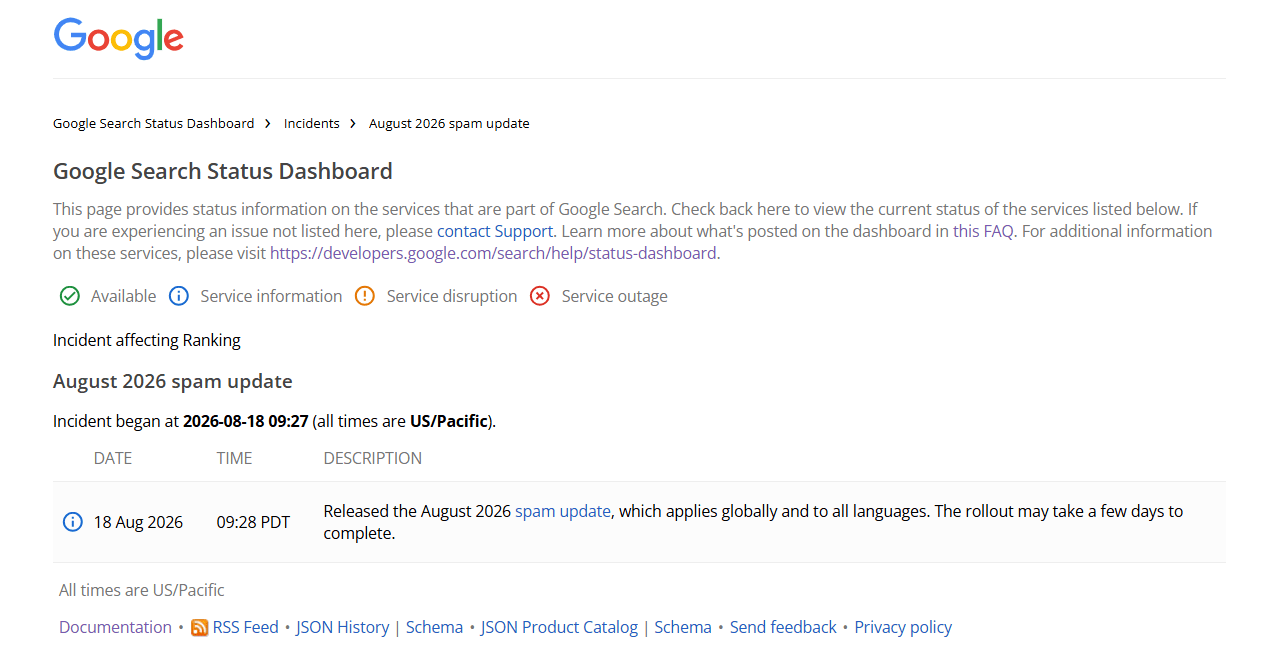
Google confirmed its third spam update of 2026 on August 18. The announcement was deliberately broad: the update applies worldwide and across all languages, and the rollout may take a few days. Google did not publish a companion technical post or name a new spam policy.
That leaves one useful way to assess risk: compare any movement with the rollout window, then examine the affected pages and site patterns against Google’s existing spam policies. Do not reverse engineer one day of volatility into a confident diagnosis.
The Confirmed Facts
| Fact | Confirmed detail |
|---|---|
| Started | August 18, 2026 at 9:27 a.m. Pacific. |
| Status | Active as of August 19. No completion time has been posted. |
| Scope | Global, all languages, and all locations. |
| Duration | Google says the rollout may take a few days. |
| 2026 sequence | Third spam update of 2026, after March and June. |
| New policy | None announced. Existing spam policies apply. |
| Named targets | Google did not disclose a tactic-by-tactic target list. |
| Recovery | Google says reassessment can take months after fixes. |
Source: Google Search Status Dashboard and Google Search Central.
What the Update Targets
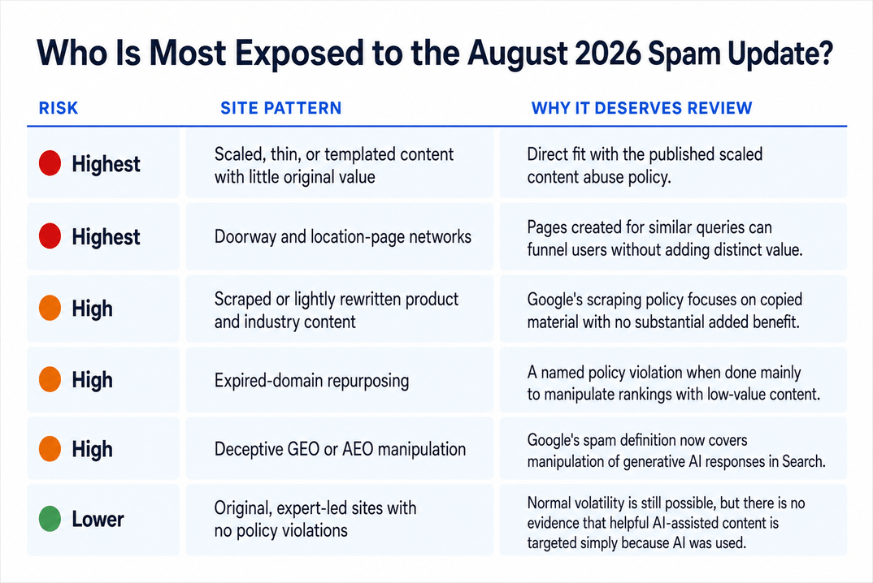
Officially: Google directs affected sites to review its existing spam policies. Those policies cover practices such as scaled content abuse, cloaking, doorway abuse, expired domain abuse, keyword stuffing, scraping, misleading redirects, and other manipulative behavior.
Reported exclusions: Search Engine Roundtable reports that Google said this rollout does not target link spam or site reputation abuse, along with some other policy areas. Those practices remain against policy even if they are not part of this rollout.
For a detailed breakdown of that policy, read our analysis of the Site Reputation Abuse policy update here
AI and GEO context: Google’s general spam definition now covers attempts to manipulate generative AI responses in Search. However, Google has not said this update specifically targets GEO, AEO, or AI-generated content as a class. The relevant risk is manipulative, scaled, or low-value production, regardless of how the content was created, a shift we explored when Google’s AI Detection Just Changed the Rules.
The B2B and industrial angle
The main B2B exposure is scalable template content: near-duplicate service-area pages, lightly rewritten supplier specifications, programmatic pages for minor keyword variations, and AI-generated product descriptions published without subject-matter review.
A stronger standard: Every indexable page should help a technical buyer make a decision. Add operating ranges, tolerances, compatibility data, test methods, failure modes, certifications, application constraints, and named expert review where relevant.
What to Do If Traffic Dropped
- Wait for completion. Do not make broad site changes while rankings are still moving.
- Verify the timing. Compare the first visible decline with August 18. A drop that began earlier needs a different diagnosis.
- Segment the impact. In Search Console, compare affected and stable pages, queries, countries, devices, and page templates. This process aligns with the tracking tactics outlined in Google Search Console Just Made Your Website Optional.
- Audit the governing policy. Map each affected page group to Google’s published spam policies. Check Page Indexing and Manual Actions for overlapping issues.
- Fix the underlying model. Improve pages with original evidence and expert input, consolidate duplication, and remove pages that cannot provide distinct value.