If you’ve ever tried hiring a digital marketing agency, you already know how overwhelming it can feel. Everyone claims to be “data-driven,” “creative,” and “results-focused.” But what really separates the great agencies from the rest isn’t just their portfolio — it’s how they think, plan, and communicate.
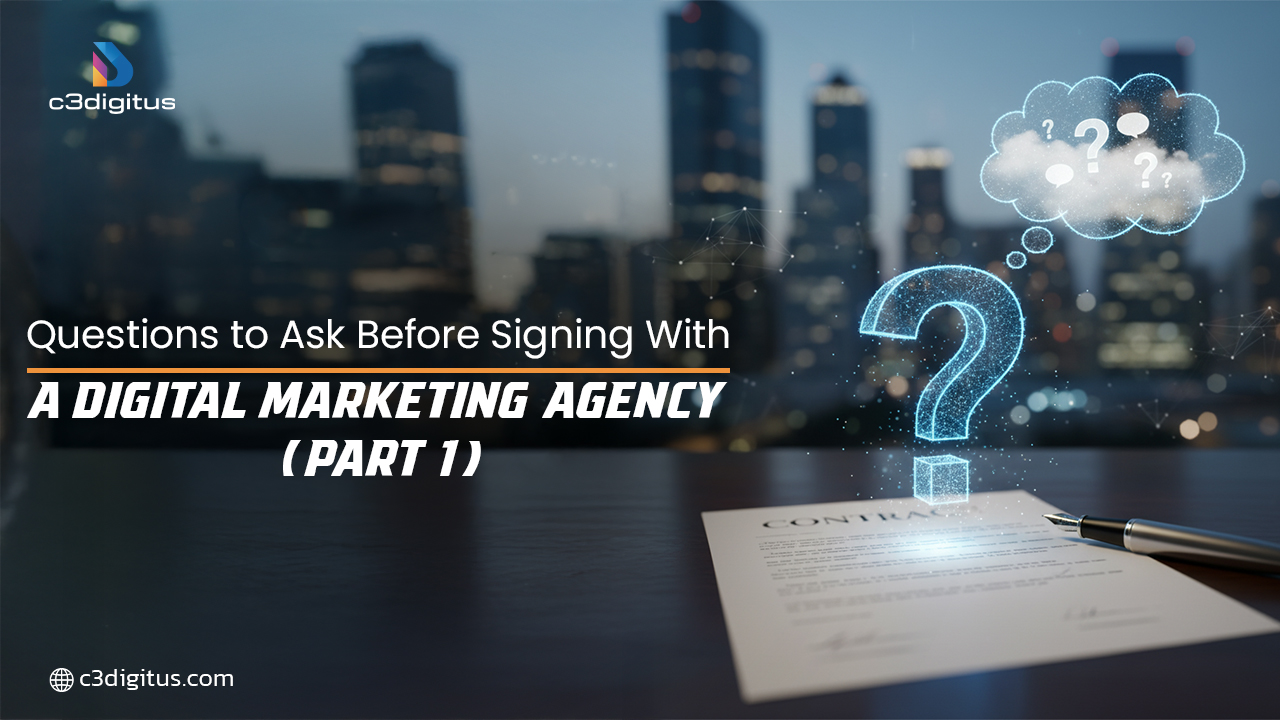
Before signing a single contract or sending a deposit, you should know exactly what to ask a digital marketing agency. These questions uncover how an agency works behind the scenes — how they plan campaigns, measure success, and treat clients.
In this Blog, we’ll go through 30 essential questions to ask a digital marketing agency, along with explanations written for real U.S. business owners — clear, direct, and practical.
Let’s start with the first four categories that define the foundation of every great agency partnership.
1. Strategic Alignment & Goals
Every effective partnership begins with a shared vision. The questions in this section help you find out whether an agency truly understands your goals and has the strategic maturity to reach them.
Ques: Who are some of your previous clients, and can you provide case studies relevant to the U.S. market?
A reliable agency won’t hesitate to show proof of success. Case studies are like a window into how the team performs under real-world conditions. When reviewing them, look for examples that match your business model or target region — for instance, if you run a medical practice in Texas, see whether they’ve helped other healthcare brands in the U.S.
A strong case study includes the challenge, the strategy, and measurable results such as “a 45 percent increase in qualified leads within six months.” If an agency only provides vague testimonials without data, that’s a red flag.
Ques: How will you work with us to define and achieve our company’s business goals?
You’re not hiring an agency to post pretty pictures or run random ads — you’re hiring them to meet your business objectives. A seasoned partner will start every engagement with a discovery phase. They’ll ask about revenue targets, ideal customers, sales funnels, and pain points.
For example, if your goal is to attract more U.S. enterprise clients, the agency should recommend a mix of LinkedIn Ads, long-form SEO content, and lead-nurture email flows rather than generic brand campaigns. Their ability to connect tactics to outcomes tells you whether they think strategically or just execute tasks.
Ques: How do you measure success — what key metrics do you prioritize?
This is one of the most revealing questions to ask a marketing agency. Anyone can say they “drive engagement,” but what does that mean?
Ask the agency to define their success metrics in your terms: ROI, cost-per-lead, lifetime value, or conversion rate. The best partners focus on the numbers that actually affect your bottom line — not just vanity metrics like impressions or likes.
If they mention analytics tools like GA4, HubSpot, or Looker Studio, that’s a good sign they track data seriously.
Ques: What did you like about our previous agency (if any), and how will you avoid repeating what didn’t work?
If you’ve worked with another agency before, be transparent. Maybe the communication was slow or the results were inconsistent. A smart agency will ask follow-up questions to understand those gaps.
Look for empathy and problem-solving here. If they immediately blame your old agency without learning the full story, they may not handle challenges well. The right partner listens, diagnoses, and designs a plan to improve.
Ques: What timeframe do you expect before we start seeing meaningful results (in a U.S. context)?
Every U.S. market behaves differently. SEO campaigns can take three to six months to gain traction, while paid search or social ads might show progress within weeks.
An honest agency will outline what you can expect in phases — for instance:
- Month 1–2: data collection and testing
- Month 3–4: optimization and traffic growth
- Month 5–6: measurable ROI
If they promise “instant results,” that’s unrealistic. Sustainable growth takes strategy and time.
Ques: How do you keep your strategic approach up-to-date with U.S. market trends (regulation, privacy, consumer behavior)?
Digital marketing evolves daily — from Google algorithm updates to state-level data privacy laws like CCPA. Agencies that invest in continuous learning stand out.
Ask if they subscribe to U.S. marketing publications, attend conferences, or train their team regularly. Staying ahead of trends means your campaigns won’t get blindsided by sudden changes.
Ques: What is your approach if our business pivot or target market changes mid-campaign?
Business goals can shift quickly — a new product, a new state, or a rebrand. Your agency should be flexible enough to adapt.
A professional partner will review your new objectives, audit current campaigns, and realign budgets without drama. Flexibility and transparency during transitions are signs of a true long-term partner.
2. Offerings & Capabilities
Now that you know how the agency thinks strategically, you need to understand what they can actually do.
Ques: What services do you offer — and do you consider yourselves a full-service agency or a specialist in certain channels?
This is one of the first agency FAQ items you should clarify.
A full-service agency covers everything — SEO, PPC, social media, email, content, web design — under one roof. A specialist agency might only handle one area, such as paid search or content marketing.
Full-service agencies are convenient for businesses wanting unified strategy; specialists are ideal for laser-focused needs. The key is to choose the right digital marketing agency and match their strengths to your priorities.
Ques: How much of the work is done in-house vs. outsourced or subcontracted?
Many agencies outsource tasks like graphic design or technical SEO. That’s not necessarily a bad thing — it can even reduce costs. But transparency matters.
Ask which parts are handled internally, who manages freelancers, and how quality control works. You should always know who’s touching your brand and data.
Ques: Do you have experience working with U.S. regulations (FTC, CAN-SPAM, GDPR-type privacy)?
Compliance isn’t just legal red tape — it’s brand protection. An agency that ignores U.S. laws can get you fined or banned from platforms.
Ask for examples of how they’ve kept campaigns compliant. For instance, they should clearly label sponsored posts, follow CAN-SPAM rules in email marketing, and secure personal data according to CCPA.
Ques: Can you support our entire digital stack (website, SEO, paid ads, social, content, analytics)?
In 2025, digital marketing is interconnected. A change in one channel often affects another.
An agency that manages your full digital ecosystem can keep everything synchronized — your ads drive to optimized landing pages, your SEO supports your paid keywords, and analytics tie it all together.
If they can’t handle all channels, make sure they coordinate seamlessly with your internal teams or other vendors.
Ques: What is your experience in our industry or with companies of our size in the U.S.?
Every industry has its nuances. A B2B manufacturer’s lead funnel is very different from an e-commerce brand’s. Ask for examples from your vertical and similar company sizes.
An experienced agency can speak your language, understand your buyer’s mindset, and anticipate industry-specific challenges such as long sales cycles or seasonality. This level of specialization is often what differentiates the marketing agency vs in-house team.
Ques: Do you handle multi-state (U.S.) campaigns if needed (localized states, time zones, local laws)?
If your business serves multiple regions — say, California and New York — your marketing will need localization. A good agency adjusts messaging, scheduling, and budgets for each region while keeping your core brand voice consistent.
They should also understand state-specific advertising restrictions or licensing requirements if your industry demands it.
Ques: How do you integrate offline and online marketing efforts (if applicable) for the U.S. market?
Offline channels — like events, print ads, or trade shows — can strengthen your online results when connected correctly.
For example, if you host a booth at a Las Vegas expo, the agency might run geotargeted digital ads to attendees’ devices or remarketing campaigns to people who visited your stand. That synergy helps your brand stay top-of-mind.
3. Team & Collaboration
You’re not just hiring services; you’re hiring people. Chemistry, communication, and clarity define whether your partnership thrives.
Ques: Who will be working with us on a day-to-day basis (team members, roles)?
Ask to meet the actual team, not just the salesperson. Your daily contacts might include an account manager, content strategist, ad specialist, and data analyst.
Get to know their experience levels. The more senior the team, the more strategic insight you’ll receive.
Ques: How many other clients will the same team members be handling?
Capacity affects quality. If your account manager juggles 15 clients, they might not give you the attention you need.
Agencies that limit workloads per manager typically deliver faster responses and deeper strategic thinking. It’s okay to ask about this balance upfront.
Ques: Does the team have U.S.-based support (time zone, office location) or is the work remote/international?
Time zone alignment can make collaboration smoother. If your agency is abroad, discuss how they’ll accommodate meetings, holidays, and cultural nuances.
Many agencies now operate hybrid models — U.S. account managers paired with international production teams — which can be cost-effective if communication is well-structured.
Ques: How do you ensure the team understands our brand voice, U.S. audience, and unique value proposition?
Consistency builds trust. The agency should request brand guidelines, tone examples, and competitor analysis before launching anything.
Some agencies run “brand-immersion workshops” to learn your story and customer personas. This step ensures that every blog, ad, or email sounds authentically you — not templated.
Ques: How do you handle feedback and revisions — what’s your process for collaboration?
Creative work thrives on feedback. Ask how many revision rounds are included and how the agency prefers to receive comments — through shared documents, project boards, or meetings.
The right agency treats feedback as teamwork, not tension. They explain their creative choices while remaining open to adjustment.
Ques: How often will we meet or have status check-ins?
Routine communication keeps projects moving. Many agencies schedule weekly check-ins for active campaigns and monthly strategy reviews for big-picture discussions.
If your campaigns run across multiple channels, insist on a central performance review so everyone stays aligned.
Ques: What meeting formats do you use (video, in-person, screen-share), and how do you handle U.S. time zones and holidays?
Most agencies rely on Zoom, Google Meet, or Microsoft Teams. But make sure they plan around U.S. business hours and federal holidays.
For example, an agency that schedules key meetings on Thanksgiving week might not understand your market rhythms.
Ques: What is the level of responsiveness we can expect (turnaround times for queries, emergencies, approvals)?
Ask for specific response timelines — perhaps within 24 hours for general requests and same-day for urgent issues.
You can even test this during early discussions: how quickly do they reply to your emails now? Their behavior before signing often reflects how they’ll act afterward.
4. Tools, Technology & Reporting
Behind every strong campaign is solid data. These questions help you see whether the agency has the right systems to track performance accurately and transparently.
Ques: What project-management and communication tools do you use?
Reliable agencies use organized systems like Asana, ClickUp, or Monday.com to manage timelines and deliverables. These tools create visibility so you can check progress anytime instead of chasing updates by email.
If an agency still tracks tasks in spreadsheets, they might struggle with accountability.
Ques: Which marketing software platforms do you specialize in (for example, U.S.-focused ad platforms, CRM, analytics)?
Ask for a rundown of their tech stack. Examples include Google Ads, Meta Ads Manager, HubSpot CRM, SEMrush, and GA4.
Their familiarity with these platforms signals their technical depth. Bonus points if they have official certifications — like Google Partner or HubSpot Solutions Provider — which prove verified competence.
Ques: How do you manage our data, track campaigns, and ensure U.S. compliance around data storage and privacy?
Data safety is serious business. A reputable agency stores and processes data securely, follows the U.S. CAN-SPAM Act for emails, and complies with California’s CCPA laws.
Ask where servers are located, who has access, and how they protect customer information. It’s not just about ethics — one leak could damage your reputation.
Ques: What kind of reporting dashboard will we receive and how often (U.S.-specific metrics)?
You shouldn’t need a Ph.D. to read your reports. Dashboards should present metrics in plain English: traffic, conversions, cost per lead, and ROI.
Ask whether they can customize views for different stakeholders — for instance, executives might want ROI summaries while marketing teams need granular data.
Ques: How transparent are you with performance data and attribution for U.S. campaigns?
Transparency is the foundation of trust. An ethical agency gives you direct access to ad accounts and analytics dashboards.
If they hesitate to share raw data, that’s a problem. You should always own your performance insights — after all, you’re paying for them.
Ques: How do you handle A/B testing, experimentation, and optimization for U.S. audiences?
Testing separates average campaigns from great ones. Ask about their process for A/B tests on headlines, landing pages, or ad creative.
For instance, they might test two Facebook ads targeting different age groups in California to see which performs better. Continuous testing and optimization ensure you’re never relying on guesswork.
Ques: How do you handle integration with our internal tools (CRMs, tracking, U.S. payment systems, state laws)?
Your marketing data should flow smoothly between platforms. Whether you use Salesforce, Shopify, or QuickBooks, the agency should connect these systems to streamline reporting and sales follow-up.
Integration errors can cause lost leads or inaccurate ROI numbers, so ask who’s responsible for setup and maintenance.