
Facebook continues to evolve in 2025 with platform-wide changes that strongly emphasize video, personalization, and content quality. These updates are not just surface-level tweaks. They directly influence how creators grow their audience, how marketers plan and run ad campaigns, and how everyday users experience their Facebook feed.
This Facebook Update 2025 guide breaks down the most important changes in simple terms and explains how creators, marketers, and users can adapt effectively.
What’s New in Facebook Update 2025
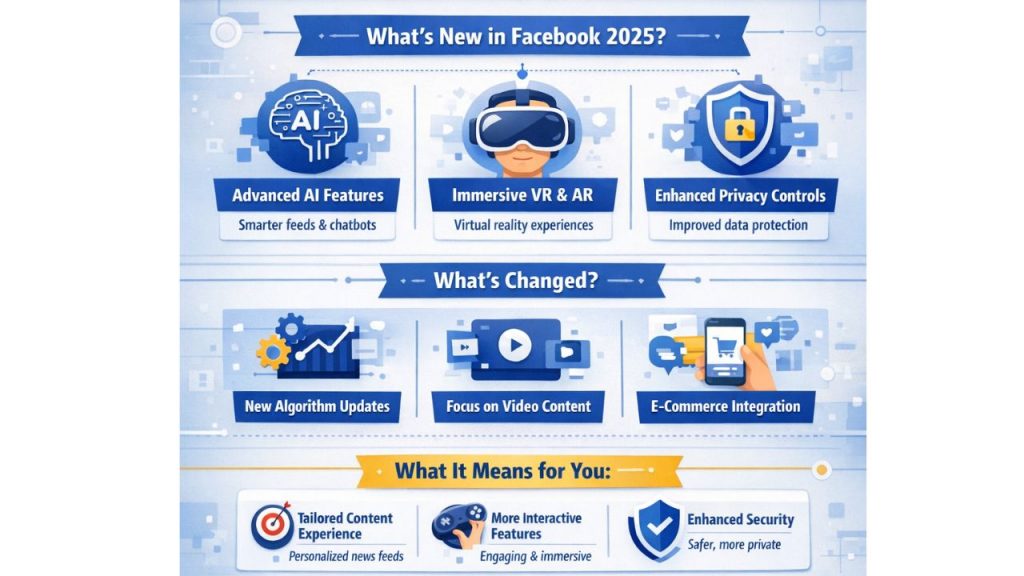
The new update on Facebook is less about adding brand-new features and more about reshaping how people use the platform. Facebook is actively pushing content that feels authentic, encourages real engagement, and keeps users watching or interacting longer.
Video continues to dominate visibility, while community-driven interactions now carry more weight than vanity metrics. These shifts are designed to improve user experience and reduce low-quality or spam-driven content across the platform.
Below is a clear breakdown of what changed throughout 2025 and why it matters.
Facebook Update Timeline 2025: Key Changes Explained
January: Cross-Posting from Threads to Facebook
Facebook introduced cross-posting from Threads, allowing users to share Threads app content directly to Facebook without recreating posts.
This change makes content distribution easier for creators and brands managing multiple Meta platforms. It also helps maintain consistent messaging while saving time and effort.
Why it matters
- Creators can expand their reach across platforms with minimal extra work.
- Brands gain wider content distribution without duplicating posts.
February: Live Videos Deprecated
Facebook removed traditional live video publishing for most users and significantly reduced its visibility across feeds.
The platform found that edited, on-demand videos perform better than raw live streams in terms of retention and overall user experience.
Why it matters
- Pre-recorded and edited videos consistently achieve higher engagement.
- Marketers should shift focus toward Reels, short videos, or scheduled video premieres.
March: Community Notes Rollout
Facebook launched Community Notes to add context and clarity to posts, particularly around news, trending topics, and informational content.
This feature allows users to provide additional information, helping reduce misinformation and improve trust on the platform.
Why it matters
- Content accuracy now directly affects trust and reach.
- Brands and creators must prioritize transparent and factual messaging.
April: Friends Tab Revamp
The Friends tab was redesigned to prioritize posts from personal connections over public or viral content.
This update reflects Facebook’s renewed focus on meaningful social interactions rather than passive content consumption.
Why it matters
- Organic reach from personal profiles is stronger than Pages alone.
- Community-driven engagement outperforms one-way broadcasting.
May: Crackdown on Spam Accounts
Facebook intensified its action against spam accounts, fake profiles, and low-quality engagement tactics.
Automation tools, engagement pods, and recycled content are now detected and penalized more aggressively.
Why it matters
- Engagement farming and artificial growth strategies no longer work.
- Authentic interactions are consistently rewarded.
June: All Videos Treated as Reels
Every video uploaded to Facebook is now categorized and distributed as a Reel, removing the distinction between standard videos and Reels.
This solidifies short-form, vertical video as the default content format on the platform.
Why it matters
- Vertical video is no longer optional.
- Video length matters less than retention, watch time, and viewer engagement.
July: Music Added to Text Posts
Facebook introduced the option to add music to text-only posts, giving written content more emotional context and visibility.
This update allows users to express mood and tone without relying on visuals.
Why it matters
- Text posts regain reach when paired with audio.
- Ideal for storytelling, announcements, and brand voice building.
August 2025: AI Video Translation Expansion
Facebook expanded AI powered video translation and voice syncing across more languages.
This helps videos feel native to global audiences without manual localization.
Why it matters
- Brands can scale video reach internationally without additional production costs.
- Expands audience reach by automatically localizing video content, giving marketers a scalable way to engage multi-lingual communities.
September 2025: Unified Content Monetization Program
Facebook merged Reels, in-stream ads, and bonus programs into one monetization system.
Creators now manage earnings through a single dashboard.
Why it matters
- Simplifies revenue tracking and encourages consistent content publishing across formats.
- Gives merchants greater control of transaction experience and data while reducing platform processing costs.
- Simplifies group interaction models and pushes engagement back into core group posts and comments.
October: Messenger Desktop Apps Discontinued
Facebook shut down Messenger desktop apps for Windows and Mac, making messaging primarily mobile-focused.
Users can still access Messenger through browsers, but dedicated desktop apps are no longer supported.
Why it matters
- Messaging is now clearly mobile-first.
- Businesses must optimize mobile inbox experiences and automation.
November: Increased Emphasis on Original Content Attribution
In November, Facebook rolled out stronger original content attribution signals to better identify and reward original creators.
Posts and videos that are first published by the original creator now receive clearer attribution and stronger distribution compared to reposted or scraped content.
Why it matters
- Original creators benefit from improved reach and visibility.
- Reposted content without meaningful value sees reduced performance.
- Brands must focus on creating first-party content rather than recycling trends.
December: AI-Powered Feed Personalization Enhancements
In December, Facebook enhanced AI-driven feed personalization to better match content with individual user interests and behavior patterns.
The platform now analyzes watch time, interaction depth, and content preferences more precisely to deliver relevant posts and Reels.
Why it matters
- Highly relevant content receives more consistent visibility.
- Creators benefit from niche-focused content strategies.
- Users experience feeds that feel more personalized and less repetitive.
2025 Facebook Algorithm Changes You Should Know
In 2025, Facebook has refined its algorithm to focus purely on intent and relevance, rather than volume-based engagement. Content is now ranked using predictive relevance scoring, where the system estimates how likely a user is to meaningfully interact with a post. Actions such as dwell time, thoughtful comments, and shares with context carry far more weight than likes or quick reactions.
The algorithm now prioritizes engagement depth over engagement volume. Posts that spark real conversations consistently outperform those with high reaction counts but little discussion. At the same time, negative feedback signals such as hiding posts or scrolling past content quickly reduce reach faster and can affect future posts from the same Page.
Originality plays a major role in distribution. Reposted, duplicated, or lightly edited content is algorithmically downranked, while first-published and unique content receives wider testing. Facebook has also recalibrated relationship strength, favoring content from Pages and people users interact with recently, not just those they followed long ago.
Finally, trust history and content integrity act as long-term ranking modifiers. Pages with consistent, accurate, and transparent content see better reach, while clickbait-style captions, poor caption content alignment, and cross-posted duplicates face distribution throttling. Overall, the 2025 Facebook algorithm rewards relevance, trust, and meaningful interaction not shortcuts.
New Facebook Reels Format: What Changed
The new Facebook Reels format reinforces video as the primary content type on the platform. Reels are now designed to feel natural, human, and immersive.
Vertical full-screen videos dominate feeds, and strong hooks within the first three seconds are critical. Facebook favors content that feels authentic rather than overly polished or ad-like.
For creators, educational and relatable Reels consistently perform best, while long-term consistency beats chasing viral moments.
For brands, Reels should look native and blend into the feed. Ads that feel like organic content outperform traditional promotional creatives.
Facebook Ads 2025 Changes: What Marketers Must Adapt To
In 2025, Facebook Ads have moved decisively toward AI-led optimization and intent-based delivery, requiring marketers to rethink control-heavy strategies. Instead of relying on tightly defined targeting rules, the algorithm now evaluates ads through a broader system built on inventory, signals, predictions, and relevance scoring.
Every time an ad is eligible to appear, Facebook pulls from its ad inventory and analyzes a growing set of signals—including on-platform engagement, post-click behavior, and historical conversion quality. These signals feed into advanced predictive models that estimate which ads are most likely to drive meaningful outcomes, such as conversions or high-quality engagement, in real time.
Creative performance has become one of the strongest signals in this process. The algorithm closely monitors how users interact with ads—watch time, scroll behavior, reactions, comments, saves, and whether users hide or skip the ad. Creatives that generate positive engagement are quickly prioritized, while those triggering negative signals are suppressed. As a result, authentic, native-looking ads consistently outperform overly polished or sales-heavy formats.
Audience targeting has also evolved. Rather than favoring narrow interest stacks, Facebook now prefers larger, more flexible audiences, allowing AI to identify high-intent users based on behavior patterns and predictive likelihood. This shift gives the algorithm more room to test, learn, and optimize across the inventory.
Finally, ad relevance and delivery efficiency are increasingly tied to account-level trust and data quality. Clean conversion tracking, reliable event data, and policy-compliant accounts provide stronger signals, enabling faster learning and more stable performance. Weak or inconsistent data, on the other hand, limits prediction accuracy and slows optimization.
Overall, Facebook Ads in 2025 reward marketers who align with how the algorithm actually operates, by focusing on strong creatives, high-quality signals, and AI-friendly structures, rather than micromanaging targeting or chasing short-term tactics.
What does this Facebook Update Means for Different Users?
For creators, Reels are now mandatory, not optional. Authenticity matters more than high production value, and text posts still perform when paired with music or discussion prompts.
For marketers, organic and paid strategies must work together. Creative quality drives ad performance, while spam tactics hurt long-term visibility.
For everyday users, Facebook feels more personal. Feeds contain less repetitive content, reduced spam, and improved control over interactions and conversations.
Facebook Update 2025 makes one thing clear: the platform has fundamentally shifted toward being video-first, trust-driven, and engagement-focused. Success on Facebook is no longer about volume, shortcuts, or recycled tactics. Instead, it’s about creating original content that holds attention, sparks meaningful interaction, and aligns with how users actually behave on the platform. From treating all videos as Reels to prioritizing engagement depth over surface-level reactions, Facebook is rewarding quality, relevance, and authenticity more than ever before. For creators and marketers alike, adapting early is the real advantage. Those who embrace short-form video, invest in creative quality, respect community dynamics, and work with the algorithm rather than against it will see more stable and sustainable growth. Meanwhile, outdated practices—spam tactics, engagement farming, and low-effort reposting—are steadily losing effectiveness. Facebook in 2025 isn’t just evolving; it’s clearly signaling what it wants. And those who listen closely will be the ones who stay visible, trusted, and relevant going forward.