Key Takeaways
Started: May 21, 2026, at 8:43 AM PDT · Ends: ~June 4, 2026 · Scope: Global, all languages
This is Google’s second broad core update of 2026, and the fourth confirmed ranking event in 13 weeks. If your traffic moved after May 21, this is why.
Who’s hit: AI content farms, aggregators, affiliate sites, comparison pages, anything that repackages what a better source has already published.
Who wins: Specialist publishers, first-party brands, .gov/.edu domains, anyone with genuine expertise and content only they can produce.
The real story: This dropped 2 days after Google I/O 2026. Google’s ranking system is now powered by Gemini 3.5 models. AI Overviews serve 2.5 billion monthly users. The update and the product pivot are in the same direction.
Something happened to your traffic around May 21. Before you delete half your site, cancel your SEO retainer, or blame your developer, read this.
Google officially released the May 2026 core update on May 21, 2026, at 8:43 AM PDT. It’s live right now. It will keep shifting rankings until approximately June 4. And no, there’s no patch, no fix, no specific thing you violated. That’s not how core updates work.
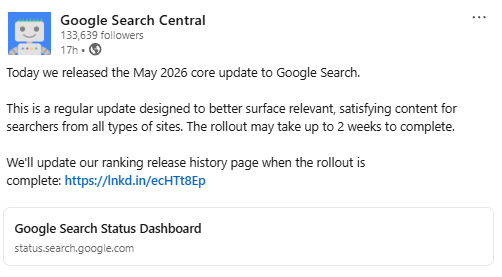
Here’s what’s actually happening, backed by real data from the March 2026 cycle and what Google revealed at I/O 2026 two days before this dropped.
The Hard Facts On Google May 2026 core update (No Speculation)
Topic | Details |
Live since | May 21, 2026 — 8:43 AM PDT |
Finishes | June 4, 2026 (up to 2 weeks) → Don’t draw conclusions until then |
Type | Broad core update — not a spam or manual penalty |
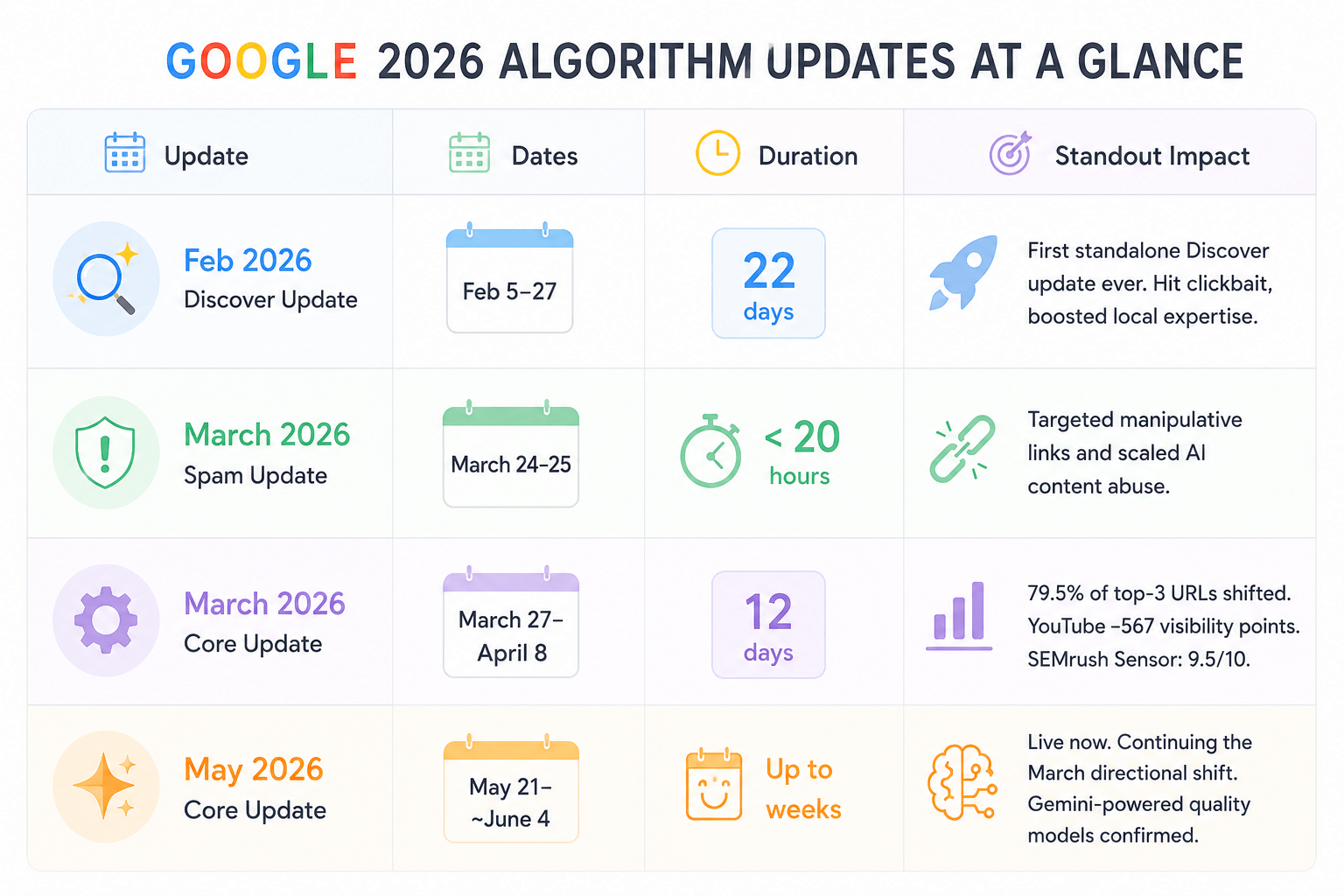
2026 ranking events | 4th total: Feb Discover → March Spam → March Core → May Core |
Running alongside? | No spam update this time — cleaner attribution than March 2026 |
Scope | Global. Every region. Every language. Every industry. |
Official new guidance? | None. Google’s existing core update guidance applies. |
Powered by | Gemini-based quality models — Google confirmed this in May 2026 |
Data context from March 2026:
79.5% of top-3 URLs shifted. SEMrush Sensor hit 9.5/10, one of the highest volatility scores in years. 24% of top-10 pages fell completely out of the top 100. AI content farms lost 60–90% of traffic. May 2026 continues that directional pressure.
The Real Story: This Isn’t Just a Routine Update
Google dropped this update 48 hours after Google I/O 2026. That’s not a coincidence, it’s a signal.
At I/O (May 19–20), Google’s Head of Search, Liz Reid, announced a major AI-driven update to Google Search powered by Gemini 3.5 Flash. The new system uses AI agents that can gather and process information in the background continuously. AI Overviews already reach 2.5 billion monthly users, and Google is now showing more AI-generated answers instead of traditional blue links.
Google also confirmed that its core ranking systems now use Gemini-based quality models, showing that both Search rankings and the overall Search experience are becoming increasingly AI-driven at the same time.
What this means for your content
Google’s AI now decides which pages to mention in AI Overviews and AI-generated answers, not just which pages rank in search results. If your content repeats the same information found everywhere else, Google’s AI can create that answer on its own, so there’s little reason to cite your page. Google calls this “non-commodity content,” meaning content with original insights, expertise, or unique value. Generic or rewritten content is becoming more vulnerable with every new update.
One week before this update dropped (May 15), Google published its first-ever consolidated guide on optimising for generative AI features in Search. The main message: there is no separate AEO or GEO strategy. Great SEO is AI-SEO. The same signals that earn rankings earn citations in AI answers.
Who Gets Hit? Who Gains. (Be Honest About Which Side You’re On)
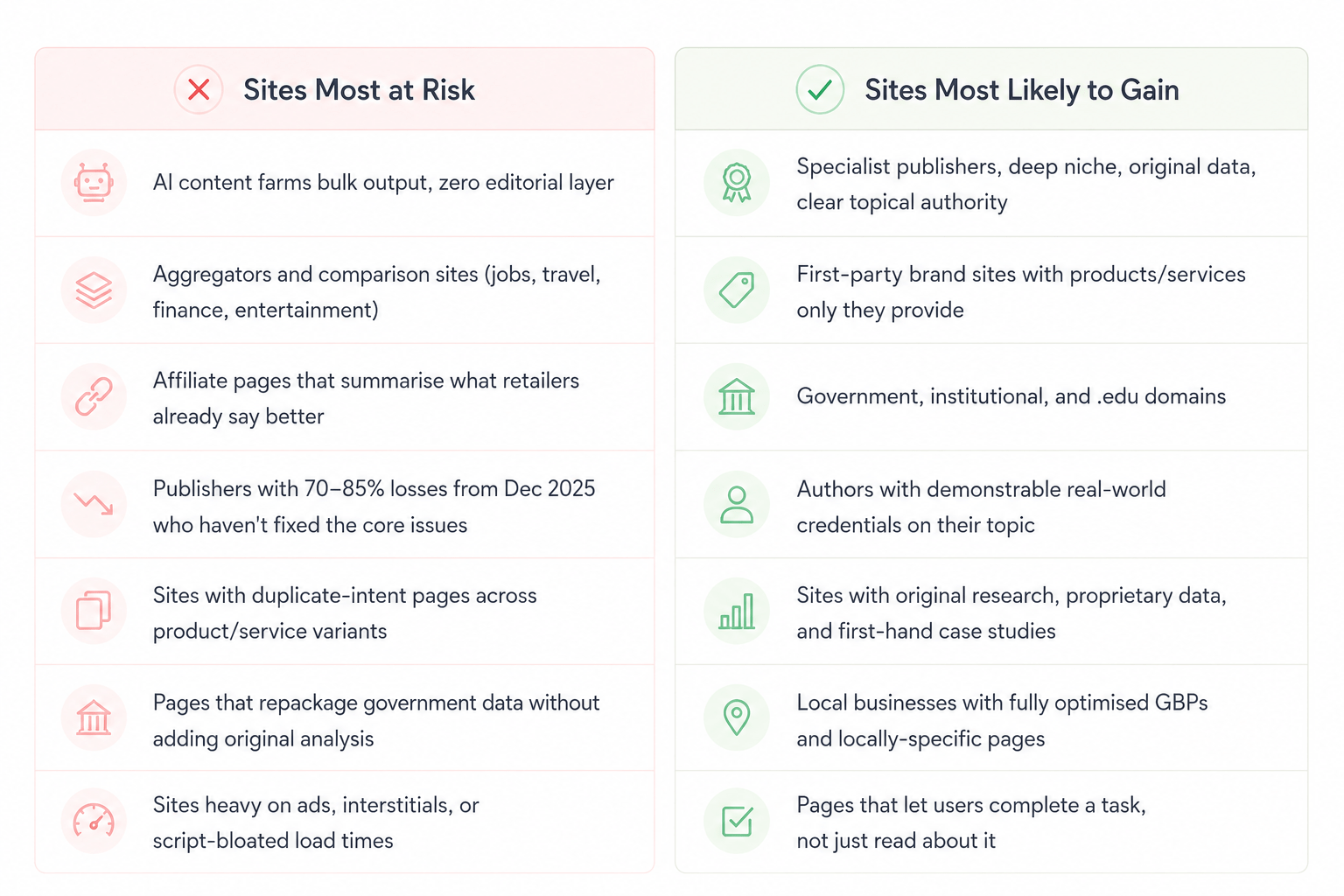
Note: YouTube, one of the largest sites on earth, lost 567 SISTRIX visibility points in the March 2026 update. Google does not automatically reward big domains. It rewards pages that are closest to the original source of value.
Wait Before You Do Anything: You Might Be Fine
Google’s own words: “There’s nothing new or special that creators need to do for this update as long as they’ve been making satisfying content meant for people.”
A core update is not a penalty. It is a recalibration. Some pages that drop haven’t done anything wrong; they’re caught in broader SERP reshuffling as Google adjusts how it weighs hundreds of quality signals simultaneously. Some of those pages recover on their own when the rollout settles. Don’t panic-delete, panic-rewrite, or panic-restructure your site mid-rollout. That is the most common mistake after core updates, and it makes recovery harder to diagnose.
What To Actually Do (The Honest Version)
Most recovery guides give you 10 steps. Here’s the honest version: there are 3 things that actually move the needle, and 2 things everyone does that don’t.
Do these 3 things:
1. Measure correctly after the rollout completes. Open Google Search Console → Performance → compare May 21+ vs. the 4 weeks before May 21. Look at pages, not just keywords. A slip from position 3 to position 6 doesn’t show as a keyword loss, but it can cut your clicks by 50%. Wait until ~June 11 (one week post-rollout) before drawing conclusions. |
2. Ask the uncomfortable question about each dropped page. Does this page say something no one else says? Is it written by someone with genuine experience of this topic? Would Google’s AI need to cite this, or could it generate the same answer from three other sources? If the answer to the last question is yes, that page is at structural risk beyond this update. |
3. Improve your highest-value pages first, not all of them. Pick your 10 most important pages by leads, revenue, or traffic. Fix those before touching anything else: add real author credentials, replace generic claims with specific data or case studies, link to primary sources instead of secondary ones, and update the publish date only if you’ve actually updated the content. |
The 2026 Google Update Timeline: Why the Pace Matters
Four ranking events in 13 weeks. If you were hit by December 2025 and haven’t fully recovered, May 2026 is your next inflection point in either direction.

Quick Answers to the Questions Everyone's Searching
Did the Google May 2026 core update already hit my site?
If you saw traffic or ranking changes on or after May 21, 2026, yes. Unlike March 2026, there is no simultaneous spam update running, so attribution is cleaner. That said, don't make final judgments until the rollout completes (~June 4) and you compare a full post-update week against your pre-May 21 baseline in Search Console.
How does this compare to the March 2026 core update?
March 2026 was savage, 79.5% of top-3 URLs moved, and SEMrush hit 9.5/10 volatility. May 2026 is confirmed to continue the same directional pressure (Gemini-powered quality models, people-first content signals). Whether it hits harder or softer than March won't be clear until the rollout settles around June 4.
My site was already hurt by the December 2025 update. Does May 2026 make things worse?
It can go either way. Some sites that were penalised by December 2025 and have since improved their content quality may see the May 2026 update as a partial recovery opportunity. Sites that were hit in December and haven't changed anything are likely to see continued suppression. Core updates are the primary mechanism for both punishment and recovery.
Does this affect Google Discover traffic too?
Yes. Core updates affect Discover, Featured Snippets, and other Search surfaces, not just organic rankings. The February 2026 Discover-specific update already shifted the Discover landscape toward locally relevant, original, expert-level content. May 2026 continues that direction.
I run a small blog / localbusiness/e-commercee store. Is this relevant to me?
Yes. This is a global update affecting all types of sites. For bloggers: audit your top posts for originality and genuine first-hand depth, not keyword coverage. For local businesses: make sure your Google Business Profile is fully active, and your service pages are locally specific and genuinely useful. For e-commerce: product pages need to answer real buyer questions with information that you have, not generic spec sheets that every retailer publishes.
What is 'non-commodity content' and why does Google keep using that phrase?
Google started using this term explicitly in May 2026 in its new documentation on generative AI search features. It means content that an AI couldn't generate itself from existing sources, original data, first-hand experience, proprietary research, and unique analysis. Commodity content is anything that restates what's already widely available. With AI Overviews serving 2.5 billion users monthly, Google's AI can generate commodity answers itself. It needs to cite you only when you have something it can't synthesise on its own.
When will I see recovery?
Partial recovery can happen during and after the rollout; some pages will stabilise naturally. But Google has been consistent on this for years: the biggest recovery windows align with subsequent core updates, not the gaps between them. The next core update is when meaningful ranking shifts happen for sites making genuine improvements now.
More from c3 Digitus The 2026 Google Update Series
→ What Is a Google Core Update? The Full Explainer
→ Google’s February 2026 Discover Core Update: What Changed
→ Google Spam Update March 2026: What Was Actually Targeted
Sources
- Search Engine Land Google May 2026 Core Update Rolling Out Now
- Search Engine Journal Google Begins Rolling Out May 2026 Core Update
- SE Roundtable Google May 2026 Core Update Is Rolling Out
- PPC.Land May 2026 Core Update Full Timeline & Attribution Guide
- Amsive March 2026 Core Update: Winners, Losers & SISTRIX Analysis
- Stan Ventures Google Launches May 2026 Core Update
- Technobezz May 2026 Core Update Two Days After Google I/O
- Launchcodex Google I/O 2026: AI Search & SEO Impact
- Google Search Central Latest Documentation Updates (May 15, 2026)
- Google Search Status Dashboard Official Incident Log
- Google Search Central Core Update Guidance (Official)
Your Traffic Dropped. You want a real diagnosis, not generic advice.c3 Digitus tracks every Google update and translates algorithm changes into specific actions for businesses of every size. If your rankings moved after May 21 and you want to know what to actually do, we can help. |