
Quick summary
Who needs it: Businesses whose customers discover, compare, or buy products and services online, including manufacturers, B2B suppliers, local services, and retailers.
What to prioritize: The gap preventing a suitable customer from finding you, confirming fit, or taking the next step.
What to measure: Relevant inquiries, quoted opportunities, bookings, or profitable purchases, according to the buying process.
Best next step: Choose one customer group and one offer, improve the page that supports it, and connect promotion to a usable inquiry or purchase route.
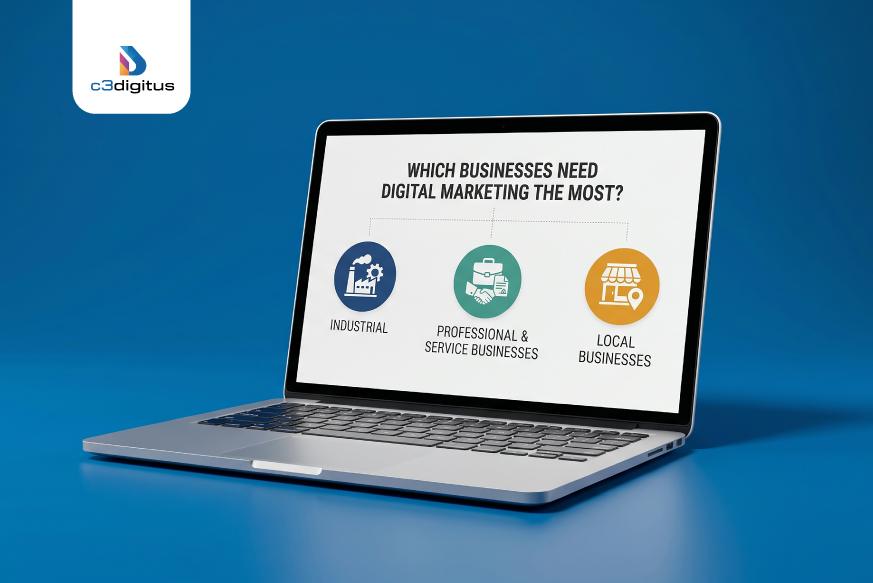
Businesses that need digital marketing most are those whose customers search for providers, compare options, or need evidence before buying. Manufacturers, B2B suppliers, service companies, online retailers, and local businesses all fit that description, but the work each needs is different.
A manufacturer may need better quotation requests from engineers and purchasing teams. A contractor may need calls from a specific service area. An online retailer needs customers who can find the right product and complete a purchase. More traffic is useful only when it supports that buying process.
This guide compares nine business types, explains how to identify your most urgent marketing gap, and shows what a practical starting plan looks like.
Nine types of businesses that need digital marketing
There is no universal ranking of industries that need digital marketing. The strongest need occurs where a visibility or information gap prevents suitable customers from finding and choosing a business. These categories overlap, so use the buying situation to set priorities.
1 Manufacturers and other B2B companies
Manufacturers, industrial suppliers, and B2B service companies need to help buyers establish technical and commercial fit. An engineer may need application details or drawings. Purchasing may need supplier qualifications and ordering information. Management may need evidence that the company can deliver.
Start with: Product and capability pages that explain what you supply, who it suits, relevant specifications, quality documentation, and how to request a quote. Support those pages with application articles and approved project examples. Keep essential evaluation information accessible without requiring a form for every download.
For digital marketing for manufacturers, a useful inquiry might include the application, expected quantity, technical requirements, and timing. Agree with sales on what makes an opportunity suitable. A high volume of requests for work you cannot supply creates additional administration.
2 Professional and service businesses
Engineering consultants, commercial maintenance providers, accountants, and contractors need prospects to understand their scope before making contact. Broad promises about quality do little to explain whether a firm handles the buyer’s particular problem.
Start with: A clear page for each distinct service, relevant experience, service locations, and an explanation of what happens after an inquiry. A maintenance provider should specify supported equipment and the information needed to arrange an assessment. Track suitable conversations and quoted work alongside calls and forms.
3 Local businesses
Restaurants, salons, repair companies, and other local providers need to be visible within the area they serve. Customers also need accurate opening hours, contact details, availability, and a simple booking or calling option on a phone.
Start with: Accurate website information and, where eligible, a complete Google Business Profile. Google’s local ranking guidance explains the importance of complete information and the roles of relevance, distance, and prominence. Track appointments and completed jobs from the right locations.
4 Ecommerce businesses
Online stores depend on shoppers finding suitable products and having enough confidence to buy. A campaign cannot compensate for unclear specifications, missing delivery information, or a difficult checkout.
Start with: Strong category and product pages, useful photographs, accurate availability, and clear shipping and returns information. Eligible products may also appear through Google Merchant Center free listings, although visibility is not guaranteed. Evaluate orders after product, promotion, fulfillment, and return costs.
5 Small and medium businesses
Digital marketing for small businesses should reflect the buying process and available capacity. A local repair shop, software company, and small manufacturer should not automatically use the same channels because they have similar employee counts.
Start with: One priority offer, a defined customer group, and a page that explains the offer well. Choose a manageable way to reach those customers and assign responsibility for responding. Expand once you understand which inquiries are useful and can serve additional demand reliably.
6 Startups and new businesses
A new company needs to establish whether its intended customers understand the offer and want it. Large audience numbers can be misleading when few people take a meaningful buying action.
Start with: A focused landing page, a product demonstration where relevant, and a small test with a spending limit. Use customer conversations to identify objections. Define the evidence that would justify continuing, such as suitable demo requests, trials that progress, or initial purchases.
7 Healthcare and wellness businesses
People evaluating a practice or wellness provider need clear service descriptions, provider qualifications, locations, and appointment arrangements. The website should help them assess the service without promising health outcomes.
Start with: Accurate service pages, a usable appointment route, and professional review of substantive health claims. Keep sensitive information within approved processes. Measure relevant appointment requests and the ability to serve those patients or clients.
8 Education and training providers
Learners and employers need to compare course content, entry requirements, schedules, delivery methods, and costs. General claims about success do not answer whether a program fits their needs.
Start with: Complete program pages, verified instructor credentials, and answers to recurring enrollment questions. For industrial training, specify who should attend and what participants will be able to practice. Review suitable applications and enrollments, including whether applicants meet the requirements.
9 Travel and hospitality businesses
Hotels, venues, tour operators, and restaurants need to help customers judge suitability before booking. Accurate photographs, location details, availability, policies, and reservation information support that decision.
Start with: Useful booking pages and content that answers questions about the stay, event, or experience. Compare direct bookings with third party bookings after fees, promotion costs, and cancellations. More reservations do not automatically mean more profitable business.
How to tell whether your business needs more marketing
Your industry establishes context. Your current sales process reveals the priority. Review recent inquiries and ask the people handling them where prospects struggle.
Customers cannot find the right offer. Check whether your important products and services have useful pages and whether relevant searches reach them.
Prospects ask questions the website should answer. Add missing requirements, limitations, examples, or process details to the appropriate page.
Most inquiries are unsuitable. Clarify the applications, locations, quantities, or project types you can support. Check which content and channels attract those inquiries.
Growth depends on a few relationships. Identify additional customer groups you can serve, then test how they discover and evaluate suppliers.
Interested prospects disappear after contact. Review response times, the information sent, and who owns the next step. Extra traffic will not resolve an unanswered inquiry.
Choose digital marketing services around the problem
Digital marketing includes search, content, advertising, email, and other online activity. Select the work that addresses the gap you have identified.
What is happening | First work to consider | Evidence to review |
|---|---|---|
Suitable buyers rarely discover your offering | Search demand review, technical checks, and relevant product or service content | Relevant search clicks and qualified inquiries |
Visitors cannot tell whether you meet their needs | Clearer pages, project evidence, and easier navigation | Visits to relevant services and suitable requests |
Buyers need to see how something works | Demonstrations, process photographs, and application content | Use in sales conversations and progressing opportunities |
Known prospects need more information | Useful follow up matched to their questions and buying stage | Replies, next steps, and sales progress |
Shoppers or prospects abandon the final step | Checkout, booking, or inquiry form improvements | Completed valid requests and purchases |
Our SEO and search visibility services address discoverability. Website design and development can improve how buyers evaluate your business and take action. Some projects need both, but the scope should follow the evidence.
Paid search can test a specific offer where relevant demand exists. Include the landing page, measurement, management, and follow up in the budget. For a manufacturer, broad consumer or informational searches may need a different approach from searches for a supplier. Inspect actual inquiries before expanding spending.
What industrial marketing work looks like in practice
The c3controls case study describes work across an ecommerce website, product navigation, educational resources, SEO, and supporting media. It illustrates a business where helping customers find and evaluate products is central to the digital experience.
The Butler Technologies case study describes a different need: additional execution capacity. The partnership includes SEO and content, LinkedIn support, video, and lead generation activity supporting its internal team.
For a business choosing marketing services, the distinction matters. One scope may begin with a difficult product experience. Another may begin with a capable team that lacks time to execute its plan. Use a provider’s examples to assess relevant experience and approach, rather than assuming another company’s results will transfer to yours.
An illustrative plan for a component manufacturer
Suppose a US component manufacturer wants inquiries from equipment builders, but its website only says it offers custom manufacturing. Buyers cannot see supported materials, typical applications, quality documentation, or what to include in a request for quotation.
The first step is to improve the relevant capability page with information approved by engineering and sales. Add an appropriate project example and a quotation route that explains what the team needs to assess the job. Request essential details while allowing a buyer with an early question to contact someone.
A supporting article could explain how to prepare a useful component RFQ, including drawings where available, expected quantities, application requirements, and desired timing. Link the article to the capability page so readers can assess the supplier after understanding the process.
Record whether subsequent inquiries match the manufacturer’s capabilities, become quotable projects, and progress to opportunities. If requests repeatedly fall outside the supported scope, clarify the content and review the traffic source. This is an illustrative plan, not a reported client outcome.
Set a practical starting budget and plan
The U.S. Small Business Administration’s marketing planning guidance connects the target market, competitive advantage, sales process, actions, budget, and measurement. Use those elements to define a scope before buying a package of channels.
First, establish the baseline. Choose one customer group and one offer. Review how customers currently find it, recent inquiries, recurring objections, and existing website activity. Define a qualified inquiry with the people responsible for sales.
Then, fix the main gap. Improve the relevant product or service page, add useful proof, and test the contact or purchase process. Publish a supporting article only when it answers a specific buying question.
Next, promote and review. Use a relevant company channel, industry publication, customer communication, or limited advertising test. Record costs, inquiry quality, and sales progress. Include internal time, content, website work, and management in the budget.
Treat the first month as a starting period, not a deadline for proving SEO returns. Longer sales cycles require later reviews of opportunities and completed business.
Who needs digital marketing services from an outside team
Outside support is useful when a clear business priority exceeds your team’s time or specialist skills. A defined website issue may need a project. Recurring content, technical improvements, and reporting may justify ongoing support.
Before hiring, agree on the problem, deliverables, review responsibilities, account ownership, and how success will be assessed. Ask who will obtain technical information from your team. These questions to ask a digital marketing agency can help structure the discussion.
Identify the marketing work your business needs next
c3digitus supports industrial and B2B companies with websites, search visibility, content, and related marketing work. Book an intro call with your website, target customers, priority offering, and the inquiries you want to attract. That gives the discussion a concrete starting point for deciding which work deserves attention first.
Frequently Asked Questions
1. Which industry needs digital marketing the most
There is no single industry that always needs it most. Ecommerce, local services, manufacturing, professional services, healthcare, education, and hospitality benefit when customers research or buy online. The urgency depends on how much suitable business is lost through poor visibility or missing information.
2. Do manufacturers need digital marketing if they sell through distributors
Yes, digital content can support buyers and distributors before an order. Accurate specifications, application guidance, product comparisons, and clear routes to authorized distributors help people evaluate the offering. Agree on how direct inquiries are routed so marketing supports the distribution model.
3. Does a small business need digital marketing if referrals already work
A clear website helps referred prospects verify services, experience, and suitability. Further investment depends on whether referrals provide enough appropriate work and whether the business wants new markets or customers. Start with the information those prospects need before adding more channels.
4. Which digital marketing service should a business start with
Start with the main obstacle. Poor discoverability may call for search work. Unclear capabilities or weak proof may call for website improvements. Slow follow up may require a better inquiry process. Review actual customer behavior before committing to a wider campaign.
5. How can a B2B company tell whether digital marketing is working
Review relevant traffic alongside inquiries, sales acceptance, quoted opportunities, and completed business. A form submission or document download is not automatically a qualified lead. Record why inquiries are suitable or unsuitable and allow for the time customers need to make a purchasing decision.