
Key Takeaways
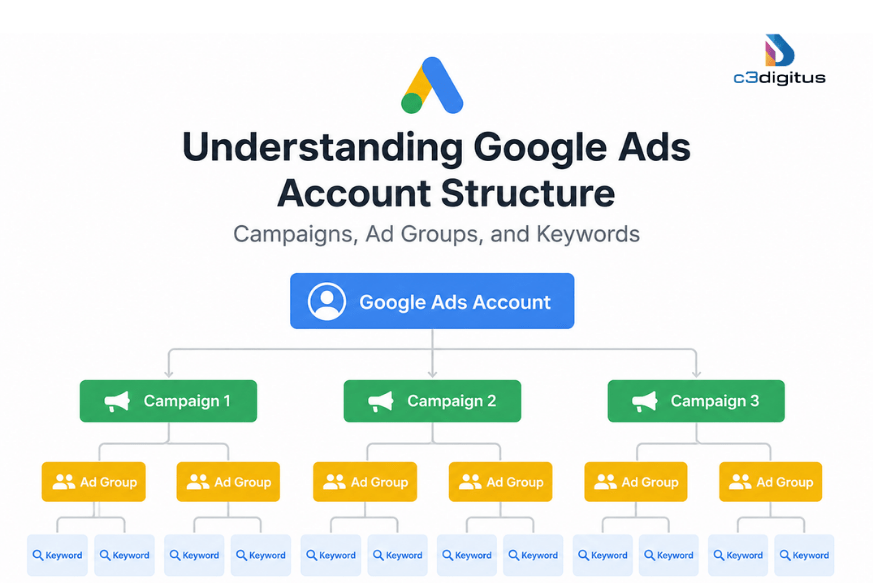
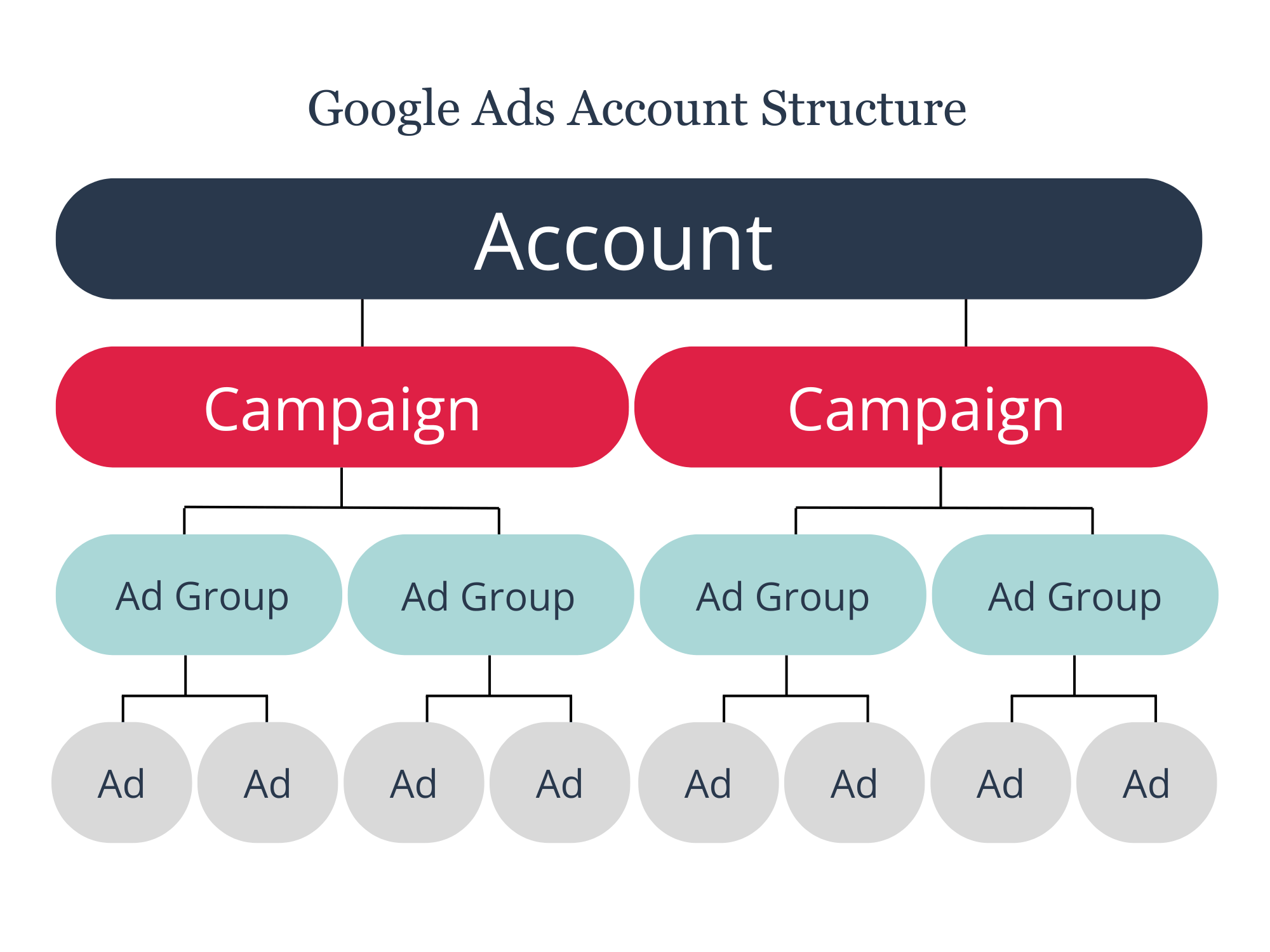
- Structure your Google Ads account logically: Account → Campaign → Ad Group → Ads.
- Create separate campaigns for different budgets, goals, locations, or bidding strategies.
- Group keywords by shared search intent to improve ad relevance.
- Use negative keywords to reduce irrelevant clicks and wasted ad spend.
- Balance account structure—avoid excessive fragmentation that can limit Smart Bidding performance.
- Regularly review search terms, keywords, ads, and campaign performance to improve results.
Running Google Ads successfully is not just about finding the right keywords or writing a catchy ad. The way your account is organized can have a major impact on how efficiently your campaigns perform.
A messy Google Ads account is like a hidden tax on your marketing budget. When campaigns, ad groups, keywords, and ads are poorly organized, it becomes harder to control spending, maintain relevance, analyze performance, and make informed optimization decisions.
Think of a Google Ads account like a well-organized department store. The account is the entire store. Campaigns are different floors or departments. Ad groups are the aisles within each department. And keywords and ads are the products people actually interact with.
If everything is placed randomly, customers struggle to find what they need. The same principle applies to Google Ads.
A clear account structure helps you create more relevant advertising experiences, reduce wasted spend, understand performance more easily, and give Google’s automated bidding systems cleaner data to work with.
Let’s break down how the structure works.
The Google Ads Hierarchy: A Bird’s-Eye View
At a basic level, a Google Ads Search account follows a simple hierarchy:
Account → Campaign → Ad Group → Keywords and Ads → User Search Query
Each level has a different purpose.
Campaigns
Campaigns control the bigger strategic decisions, such as:
- Budget
- Bidding strategy
- Location targeting
- Networks
- Language settings
- Overall campaign objective
Ad Groups
Ad groups organize closely related keywords and connect them with relevant ads.
Keywords and Ads
Keywords help determine which searches may trigger your ads, while ads deliver the actual message that users see.
The important thing to understand is that these levels are connected. A decision made at the campaign level can affect every ad group and keyword within that campaign.
For example, if you target the wrong geographic location at the campaign level, even perfectly organized ad groups and highly relevant keywords may still attract the wrong audience.
That is why a strong account structure starts from the top and becomes more specific as you move down.
Tier 1: Campaigns — The Strategic Control Room
Campaigns are where the big decisions live. Every setting here cascades down to every ad group and keyword inside it. If something is wrong at this level, it cannot be fixed further down the chain.
Budget
Each campaign gets its own daily budget. This is how you control which parts of your business get prioritized.
Suppose you run a digital marketing agency with three service lines. If all three share one campaign, a high-volume service will consume most of the budget before the others get a chance. Separate campaigns fix this:
- Campaign 1 — Brand Search: $20/day
- Campaign 2 — Lead Generation: $100/day
- Campaign 3 — High-Value Service: $50/day
Bidding Strategy
Your bidding strategy tells Google how to optimize your bids. Common options include Maximize Conversions, Target CPA, Maximize Conversion Value, Target ROAS, and Maximize Clicks. A lead generation campaign behaves differently from an ecommerce campaign, and your strategy should reflect that.
Location and Language Targeting
If you advertise across different countries or regions with different budgets or messaging needs, those markets should be in separate campaigns. Mixing them makes it nearly impossible to analyze performance or control spend by market.
When to Create a New Campaign
Create a new campaign when there is a meaningful difference in budget, bidding strategy, geographic target, campaign type, or business objective. Avoid creating campaigns for its own sake. Too much fragmentation starves each campaign of the data Google needs to optimize.
Tier 2: Ad Groups — Where Relevance Is Built
If campaigns are about strategy, ad groups are about relevance. Their job is to create a close match between what someone searches for and the ad they see in response.
The rule is simple: group keywords together only if you can write one ad that feels genuinely relevant to all of them.
Say you run a digital marketing agency offering SEO, Google Ads management, and social media services. Putting all those keywords into one ad group means every user sees the same generic ad. That kills relevance and conversion rates.
A better structure:

Campaign: Digital Marketing Services
Ad Group 1 — SEO: “SEO services”, “SEO agency”, “SEO company”
Ad Group 2 — Google Ads: “Google Ads management”, “PPC agency”, “Google Ads consultant”
Ad Group 3 — Social Media: “Social media marketing agency”, “social media management”
Tier 3: Keywords and Ads — The Final Connection
Keywords and ads are the layer closest to the actual person searching. This is where your account structure meets real human intent.Keyword Match Types
Not all keywords behave the same way. Google Ads offers three match types that control how closely a search query needs to match your keyword before your ad is eligible to appear.| Match Type | How It Works | When to Use It |
| Broad Match | Widest reach. Google matches based on intent. Best paired with Smart Bidding and strong conversion tracking. | Use to discover new search demand. Monitor search terms closely. |
| Phrase Match | Reaches searches that share the meaning or intent of your keyword. More focused than broad. | Good middle ground. Balances reach with relevance. |
| Exact Match | Tightest control. Google may still match close intent variants, not just word-for-word searches. | Best for high-intent keywords where precision matters most. |
Negative Keywords: Blocking Irrelevant Traffic
Choosing what to target is only half the job. Equally important is telling Google what not to show your ads for. This is what negative keywords do.If you sell premium Google Ads management services, you do not want ads appearing for “free Google Ads course,” “Google Ads jobs,” or “how to learn Google Ads.” Adding those as negatives stops you paying for clicks that will never convert.The Search Terms report inside Google Ads shows exactly which queries are triggering your ads. Review it regularly to find irrelevant searches, add new negatives, and spot keyword opportunities you are missing. This is ongoing work, not a one-time setup.Responsive Search Ads: Writing for Relevance
Responsive Search Ads (RSAs) let you provide up to 15 headlines and 4 descriptions. Google tests combinations automatically to find what works best for each search query. Cover different angles, not variations of the same point:- Service-focused: “Google Ads Management Services”
- Benefit-focused: “Generate More Qualified Leads”
- Trust-focused: “PPC Strategy Built Around Your Goals”
- Action-focused: “Request a Free PPC Consultation”
Structuring for Google’s Smart Bidding Systems
Smart Bidding strategies — Target CPA, Target ROAS, Maximize Conversions — rely on conversion data to make decisions. They need enough data in each campaign to learn effectively.This is why excessive fragmentation hurts. An account split into 40 tiny campaigns, each collecting a handful of conversions per month, gives Smart Bidding very little to work with. A cleaner, more consolidated structure produces better data, which produces better automated decisions.The modern principle is balance: specific enough to maintain relevance, consolidated enough to generate meaningful data, and simple enough to manage. For a full breakdown of how analytics data connects to campaign decisions, see: Website Analytics in 2026: GA4, GTM, GSC & GMB Guide.Frequently Asked Questions
1. What is the correct Google Ads account structure?
The correct structure follows five levels: Account → Campaign → Ad Group → Ads. Each level serves a specific purpose. Campaigns control budget, targeting, and bidding strategy. Ad groups organize related keywords by shared intent. Keywords determine which searches trigger your ads. Ads deliver the message the user sees. When all five levels are logically organized, the account performs more efficiently, and the data becomes easier to act on.
2. How many campaigns should a Google Ads account have?
There is no fixed number. Create a new campaign when there is a meaningful difference in budget, bidding strategy, geographic target, campaign type, or business objective. A small business might run three campaigns. A large enterprise might run fifty. The wrong answer is creating campaigns without a clear reason — too many campaigns with thin data slows down Smart Bidding and makes reporting harder to read.
3. What is the difference between a campaign and an ad group?
A campaign controls the macro decisions: how much you spend per day, where your ads appear geographically, which language you target, and how Google bids for each opportunity. An ad group controls relevance: it groups closely related keywords together and connects them to ads written for that specific search intent. Think of the campaign as the department of a store and the ad group as the specific aisle within that department.
4. How many keywords should be in each ad group?
There is no strict rule, but a useful guideline is to include only keywords you can address with a single, relevant ad. For most advertisers, that means somewhere between 5 and 20 closely related keywords per ad group. If you find yourself needing very different ad copy for different keywords in the same group, that is usually a signal to split them into separate ad groups.
5. What is a negative keyword and why does it matter?
A negative keyword tells Google which searches should not trigger your ads. For example, if you offer paid Google Ads management services, you would add "jobs," "free," "course," and "certification" as negatives to prevent your budget from being spent on clicks from people who are not looking to hire an agency. Negative keywords are one of the most direct ways to reduce wasted spend and improve the overall efficiency of an account.
6. What keyword match types should I use?
Most accounts benefit from a mix. Use Exact Match for your highest-intent, highest-value keywords where tight control matters most. Use Phrase Match to balance reach and relevance across a broader set of searches. Use Broad Match in campaigns with strong conversion tracking and Smart Bidding to discover new search demand you might otherwise miss. Avoid using Broad Match in campaigns where you lack sufficient conversion data or budget to manage the expanded reach.
7. How often should I review my Google Ads account structure?
Do a structural review at least once a quarter. Check whether campaign budgets still reflect your current business priorities, whether ad groups have maintained keyword relevance over time, and whether your negative keyword lists are up to date. Also check your Search Terms report at least once a month to catch irrelevant traffic early before it becomes a significant cost.
8. Can a poorly structured Google Ads account affect Smart Bidding performance?
Yes — significantly. Smart Bidding strategies like Target CPA and Maximize Conversions rely on conversion data to optimize bids. When an account is over-fragmented — too many campaigns each receiving only a small number of conversions — the algorithm does not have enough data to make good decisions. Consolidating campaigns where possible gives Smart Bidding a stronger data signal, which typically leads to more stable and efficient performance over time.
Quick Account Structure Audit — 3 Questions
Campaigns: Do different budgets, goals, markets, and campaign types each have their own campaign?
Ad Groups: Are keywords grouped by shared search intent — not just because they relate to your business?
Ads: Does every ad headline and description naturally match what the user in that ad group is searching for?
If any of those three questions reveals a gap, that is where to start. A clean structure does not need to be complicated — it needs to be logical. One clear purpose per campaign, one clear intent per ad group, one clear message per ad.
Not Sure If Your Google Ads Structure Is Working?
A disorganized account structure is one of the most common causes of wasted PPC spend. Our team audits Google Ads accounts for structural issues, budget leaks, and missed optimization opportunities.
→ Book Your Free Google Ads Audit →
Free 30-minute consultation. No obligation.