

AI can code. AI can compose. AI can write a brilliant marketing email. But can it feel the frustration of a software engineer tackling a complex bug? Can it channel the cultural context of a painter’s struggle? No. And this emotional and experiential gap is your only proprietary advantage in late 2025.
As AI tools erase the entry barriers for technical creation, the market is re-pricing human value, specifically the value of vulnerability, unique experience, and proprietary insight. When every piece of content is algorithmically optimized, the user’s search for meaning defaults to the human source. The question is no longer how fast you can create, but how deeply your content can connect.
This blog is your framework for injecting the proprietary data and the human “soul” that turns hollow scale into a genuine authority. We call the current saturated environment the Paradox of Perfection.
The Connection Crisis: It’s the Same Problem in Every Profession
The question of AI’s emotional and creative limitations isn’t confined to digital marketing; it’s a cultural shift impacting every professional who depends on genuine connection, innovation, and trust. This is underscored by high societal skepticism regarding the current trajectory of automated systems.
1. The Art Dilemma: Algorithms vs. Awe
AI image and music generators are spectacular. You can prompt a system to generate a “surrealist portrait of a melancholic badger in a top hat,” and it nails it. But can AI art connect the way human art does?
- The AI Output. It generates a perfect representation of the prompt. It connects concepts based on patterns it learned from millions of existing images. It’s the ultimate mimic.
- The Human Connection. The connection we feel to art is a connection to the artist’s journey. Studies show that when people know a creation is AI-generated, they consistently rate it as having lower emotional resonance and lower quality. They sense the absence of the intentional, flawed, human hand.
The Trade-Off for Creators: You can have infinite perfection (AI) or singular resonance (Human). In a world drowning in perfect content, the imperfect, vulnerable, and intentional piece is the one people will pay a premium to experience and share. Don’t let AI edit out the parts of your brand that feel messy or real.
2. The Code Conundrum: Can AI Beat Software Engineers?
This is where the real business value lies. Yes, AI can write mountains of code. Tools are getting so good that they can turn a natural language prompt into functional code in seconds. But can AI beat software engineers?
- AI’s Role: The Genius Apprentice. AI excels at the syntax (the “what”), like boilerplates and repetitive functions. Its key trade-off is speed and consistency for the lack of strategic foresight.
- The Engineer’s Role: The Systems Architect. It’s the human who handles the semantics (the “why”). Their real job is managing messy human factors: budget constraints, technical debt, and ambiguous requirements.
In 2026, the best engineer isn’t the fastest coder; it’s the one who can translate a deeply human business dilemma into an elegant, maintainable, and connected system. The AI optimizes the parts; the human owns the whole, messy vision.
The Trust Imperative: Compliance as Connection
The rise of Generative AI has amplified ethical and compliance risks around data, bias, and transparency. In late 2025, ethical content practices aren’t just legal duties; they are the new foundation for customer loyalty.
The Ethical Angle: Training Data and Bias
Most generative AI models are trained on billions of data points scraped from the internet. This creates two immediate liabilities:
- Compliance Risk (IP): The ongoing legal battles surrounding training data and copyright mean relying purely on AI-generated visuals or text is a significant legal liability for large enterprises.
- Bias Risk: If an AI is trained on historical data showing bias, it will simply output an optimized, yet still biased, strategy. This highlights a governance gap where nearly 60% of employees admit to using unapproved ‘Shadow AI’ tools, risking professional credibility.
- Decision-Making Factor: When choosing an AI tool, ask: “Where did the data come from, and who audited the output?” Prioritizing governance and transparency is no longer optional.
Your 2026 Strategy: The Three-Step “Humanization” Framework
For any high-authority digital publication or brand focused on thought leadership, the new mandate is not just creating content but curating and validating it with unassailable human authority. This strategy is essential for winning in the age of generative search.
1. The Experience-to-Authority Bridge (The E-E-A-T Accelerator)
Google’s continued emphasis on E-E-A-T (Experience, Expertise, Authoritativeness, and Trustworthiness) is the biggest clue. AI is the master of Expertise and Authoritativeness. But it’s dead silent on Experience (the critical ‘E’). That’s your goldmine.
- Action Step: Implement a mandatory First-Party Data Block. For every AI-drafted article you create, include a small section containing proprietary information that the AI could not have generated.
- Case Study Example: Instead of generic advice, try: “We analyzed our last 100 client campaigns and found that the optimal headline length for AI Overviews is $14-16$ words, not the industry standard $10-12$.” This proprietary data elevates your authority instantly.
- Link Insight: To make this unique experience discoverable and trusted by the generative AI, you must first know how to optimize for AI Overviews and chat tools. Your unique, cited experience is what helps your content rise above the generic chatter and get selected as a primary source.
2. The Context-Carrying Principle (From SEO to GEO)
Your audience’s search habits have evolved rapidly. They aren’t just typing keywords; they are having conversations with AI tools and expecting seamless context. Understanding AI search habits and consumer behavior in 2025 shows they value continuous, intelligent interaction.
The Problem: Traditional SEO focuses on a single page’s ranking. The new reality, Generative Engine Optimization (GEO), means you must be ready for your content to be consumed in snippets, audio summaries, and chatbot responses.
- Action Step: Prepare for Late-Stage Arrivals. The AI Summary handles the early filtering. Users who click through to your site have already consumed the AI’s synopsis. Therefore, your website must be prepared for users who land deeper in the funnel. Make your CTAs incredibly specific and your unique value proposition immediately apparent. They skipped the blog post introduction, so it doesn’t make them guess what AI Overview is and why they’re finally here.
3. The Transparency Premium (Disclosure as Connection)
Consumers demand transparency. This isn’t just about avoiding a lawsuit; it’s about building affinity. The desire for human interaction is spiking, with 61% of consumers concerned about the inability to speak to a real person.
- Action Step: Adopt a Clear Disclosure Policy. Instead of burying it, make transparency a point of pride.
“We use AI (like Gemini Flash) to ensure speed and data accuracy, but every insight, anecdote, and recommendation in this blog has been personally reviewed and validated by our human SMEs (subject matter experts), such as Ted Wodoslawsky and Kartik Pandya, to ensure it connects with your real-world challenges.” - Why it Works: This strategy doesn’t avoid the AI wave; it uses transparency to build the Trustworthiness that your competitors, who are still secretly publishing sterile, automated draftsare eroding.
4. The “Skin in the Game” Factor: Accountability vs. Inference
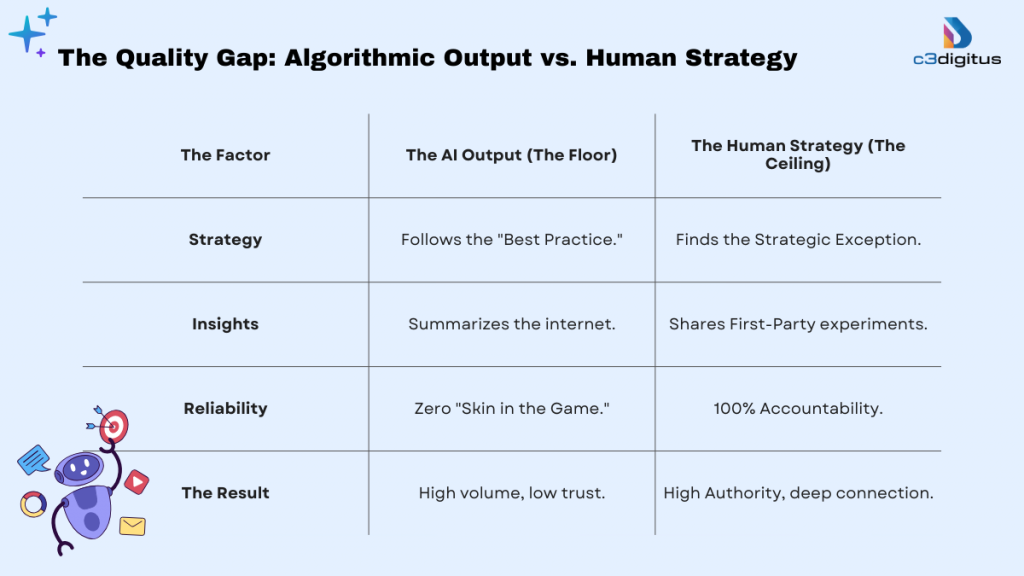
While AI operates on inference (predicting the next likely word or pixel based on the past), humans operate on intuition, the ability to make a leap based on a feeling about the future. This is the final frontier of human authority.
- The Weight of Responsibility: An AI can suggest a radical marketing pivot or a code refactor, but it doesn’t stay up at night worrying about the consequences. It has no reputation to lose. Your “proprietary soul” is the fact that you stand behind your work with your name and your career. In 2026, clients aren’t just paying for the output; they are paying for the human who is willing to be responsible for it.
- The “Gut-Check” Pivot: AI is the master of the “statistically average.” It will always steer you toward the most likely success based on yesterday’s data. But true innovation usually looks like a mistake until it works.
Only a human can look at a data-backed AI recommendation and say, “The data says ‘A,’ but the cultural temperature shifted this morning, and my gut says ‘B’.”
The Peak Strategy: Use AI to find the obvious answer, then use your human intuition to decide if the obvious answer is actually the right one. The marketplace is starving for leaders who aren’t afraid to override the algorithm when it lacks “soul.”
5. The “Friction” Value: Why the Struggle Matters
We are entering an era of “The Uncanny Valley of Aesthetics.” When content is too balanced, too symmetrical, or too perfectly structured, the human brain flags it as synthetic and ignores it.
- The Power of the Pivot: The connection we feel to a great piece of software or a haunting painting comes from the “friction”, the bugs that became features, the brushstrokes that show a shaking hand, and the marketing copy that sounds like a person, not a persona.
- The “Stomach-Drop” Edge: AI can process $10^{12}$ data points, but it has never felt the “stomach-drop” of a server crashing at 3:00 AM or the tactile resistance of a physical canvas. That lived experience allows you to write and create from a place of “Biological Truth” that an AI can only ever simulate.
The Strategy in Practice
Theory is a commodity; execution is proprietary. At c3Digitus, we use a specific framework to pressure-test whether a project is providing strategic value or simply filling space.
Run your most important project through this logic to see where your market value actually sits in 2026.
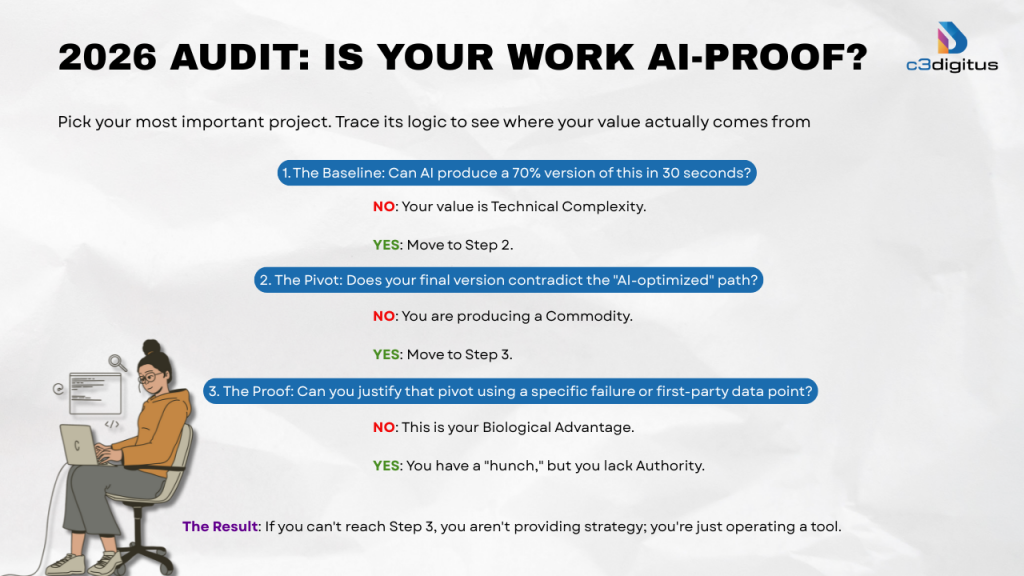
In 2026, AI is your super-efficient, yet socially awkward, co-pilot. It handles the volume, the perfection, and the grunt work of data synthesis. Your job, in marketing, art, and engineering, is to bring the unique, irreplaceable human elements: the gut feelings, the shared experience, the transparent mistake, and the compelling why behind everything you create.
The marketplace is saturated with flawless, soulless output. Your imperfections, validated by your experience, are now your best, most valuable marketing asset.
Are we truly ready to choose connection over convenience, and trade algorithmic perfection for human meaning?