
Summary
Google has officially discontinued FAQ rich results as of May 7, 2026, meaning those expandable dropdowns will no longer appear in search results. While the visual feature is gone and Search Console support will end by August, you should keep your FAQ schema to help Google’s AI better understand and cite your content. The strategy now shifts from “winning pixels” to optimizing for AI-driven answers and voice search.
If you’ve been monitoring your search traffic lately, you might have noticed a sudden dip in “pixels.” On May 7, 2026, Google officially pulled the plug on FAQ rich results. The expandable dropdowns that once helped brands dominate search real estate are now gone for good.
This isn’t just a minor tweak; it’s the final step in a phase-out that began years ago. Based on the latest updates from Search Engine Journal and Google’s official developer documentation, here is exactly what changed and how you should pivot.
The Phase-Out Timeline
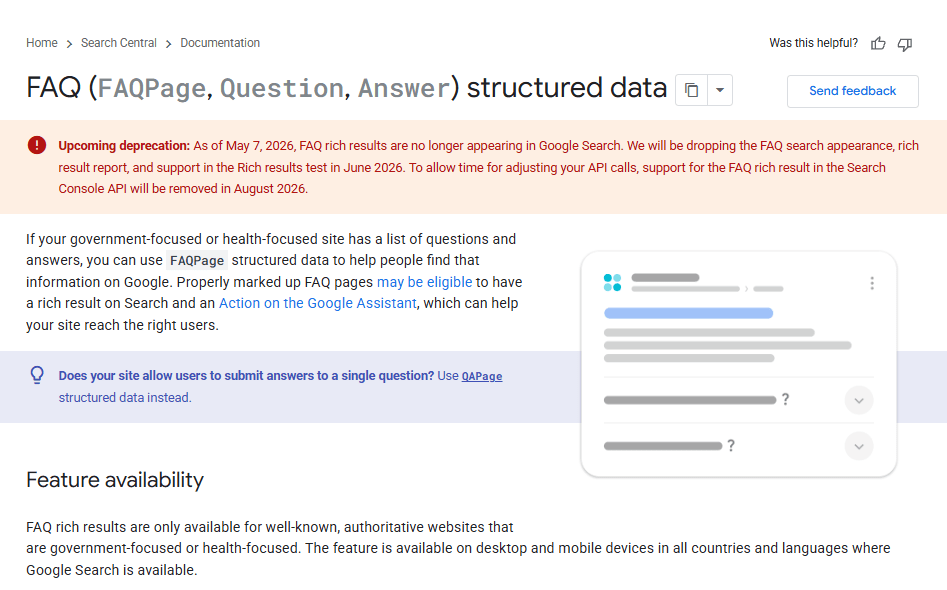
May 7, 2026 — FAQ rich results stop appearing in Google Search. All sites, no exceptions.
June 2026 — FAQ appearance report removed from Search Console. Rich Results Test stops supporting FAQ validation.
August 2026 — FAQ rich results fully removed from the Search Console API.
The Big “Why”: Cleaning Up the SERP
Why did Google kill a favorite SEO tactic? It comes down to two things: clutter and AI. The SERP became overcrowded with “spammy” or low-quality FAQs used purely to push competitors down the page. More importantly, Google is shifting toward a synthesized search experience. Instead of you providing a dropdown, Google’s AI now prefers to “ingest” your content and provide its own answer in AI Overviews.
Is FAQ Structured Data Dead?
Technically? No. Visually? Yes.
Here’s the part most coverage is getting wrong. Google has not deprecated FAQ schema markup. They deprecated the visual display of it.
The structured data still works — just behind the scenes rather than on the page. Well-formatted Q&A markup still actively helps your content appear in:
- AI Overviews — Google’s AI scans for concise Q&A pairs when building summaries. Structured markup makes your content easier to cite and extract.
- Featured Snippets — Position Zero is alive and competitive. FAQ schema helps Google identify your best standalone answer for that box.
- Voice Search — Siri, Alexa, and Google Assistant still prefer the clean Question/Answer format for audio responses.
Think of it this way: structured data was always the language AI uses to understand your content. The dropdown was just one thing Google happened to display with it. Now Google is doing something more valuable with the same information — citing you inside AI-generated answers. That’s not a demotion. For more on how Google evaluates content authority, see: What Is E-E-A-T and Its Role in SEO.
Your 3-Step Action Plan
- Audit Before June: Use the Rich Results Test now to ensure your markup is error-free before the tool stops supporting FAQ validation next month.
- Export Your Data: Download your historical FAQ performance data from Search Console before the reporting disappears in June. You’ll need this to explain any “drop in impressions” to stakeholders.
- Optimize for “Citability”: Ensure your Q&A pairs are visible on the page (not just in the code) and written in a concise, authoritative tone. Aim for 40-60 words per answer to maximize your chances of winning an AI Overview citation.
The Bottom Line
Google didn’t penalize anyone. It cleaned up the results page and raised the bar for what structured content needs to do. The brands that benefit will be the ones producing genuinely useful Q&A content — written for real people, formatted for AI to cite.
Keep the markup. Tighten the answers. Focus on being the most authoritative source in your space. The dropdowns are gone, but traffic still follows the best information. For a broader look at how recent Google changes are reshaping SEO: Google’s March 2026 Spam Update.