TLDR
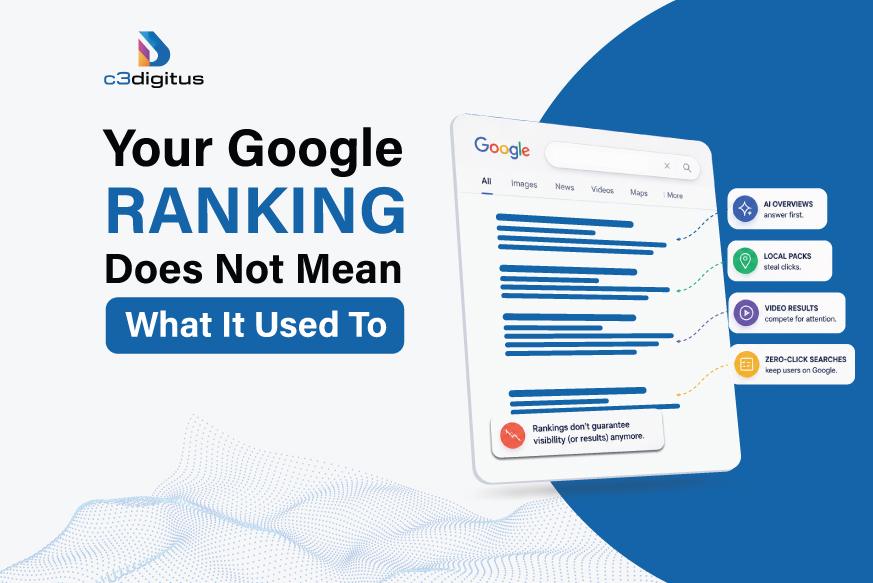
The shift: Ranking #1 on Google gives you a 31% chance of being cited in an AI answer. Rank #4 and it drops under 3%. Google ranking and AI visibility are now two separate scores. Source: NP Digital, March 2026, 500 commercial keywords.
The pattern: A significant share of AI Overview citations come from pages that rank outside the top 10 — pages that would never show up on page one of traditional search.
The fix is two parts: (1) Your page needs to lead with a direct, extractable answer. (2) Your brand needs to show up in the third-party places AI already trusts — forums, review platforms, roundup lists. The second part is what almost nobody is doing.
Quick start: Pull your five highest-traffic pages. Add a clean FAQ section at the bottom answering the real buyer questions in their exact words. That is a better use of a week than another round of keyword tweaks.
For most of the last 20 years, ranking #1 on Google was basically the whole game. Get the top spot, get the traffic. Simple.
That is not really true anymore, and I do not think enough people in industrial marketing have clocked it yet.
Ranking #1 on Google gives you roughly a 31% shot at being cited in an AI-generated answer. Rank four? Under 3%.
Source confirmed: NP Digital tested 500 top-ranking brands against 4,308 long-tail AI search prompts across five industries in March 2026. The 31% figure comes from that study, disclosed June 4, 2026 by NP Digital’s APAC managing director Dan Kalinski. The study was conducted specifically against ChatGPT, Perplexity, Gemini, and other major LLMs — not just Google AI Overviews.
And here is the part that really got me. A significant share of the pages AI tools actually pull answers from rank outside the top 10 on Google — some well beyond page one. Pages that would never even show up in traditional first-page results. Those are the ones ChatGPT and Gemini and AI Overviews are grabbing. (Source: Digital Applied / Everything-PR Citation Index, 2026)
The data behind this: Ahrefs’ March 2026 study of 863,000 keywords found the overlap between top-10 Google rankings and AI Overview citations has declined from 76% to 38% over 12 months. Digital Applied’s 2026 citation pattern study found 31.2% of AI Overview citations come from pages ranking positions 11-100, with additional citations coming from beyond position 100. The original article’s framing — ‘rank 21st or lower’ — is directionally accurate but imprecise. The more accurate statement: roughly a third of AI citations come from pages that rank outside the traditional top 10.
So your Google ranking and your AI visibility are turning into two different scores. You can win one and completely miss the other.
Keyword Matching Was Never Really “Strategy”
Let us be honest about something. Most of what we called good SEO for years was just good keyword matching. Someone searches “industrial control panel enclosures,” you build a page around that exact phrase, Google rewards it. Felt strategic at the time. Really it was a shortcut, a way to guess at what a buyer wanted without ever actually having to know.
That shortcut is running out of road fast. People are not searching in short phrases anymore, they are describing whole situations. A plant engineer is not typing “motor control center” into ChatGPT. They are explaining the fault they are chasing, the spec they are trying to hit, or the two vendors they are stuck choosing between. And the data backs this up: short one to three-word searches trigger an AI answer maybe a quarter of the time. Six words or more? Over three-quarters of the time. The longer and more specific the question, the more it looks like an actual human moment instead of a keyword, and the more AI leans in to answer it directly.
The query length data: Short queries (1-3 words) trigger AI Overview responses approximately 25% of the time. Queries of 6+ words trigger AI responses over 75% of the time. This pattern holds across Google AI Overviews, Perplexity, and ChatGPT Search — all of which are designed to handle conversational, situational queries rather than keyword fragments. Source: Multiple 2026 studies including Heroic Rankings and Advanced Web Ranking analysis.
Google Basically Told Us This Was Coming, Back in 2015
This is not some new thing generative AI invented. Google flagged it a decade ago with something called Micro-Moments. The idea was pretty simple, actually: people do not search randomly, they search from one of four states of mind.
- Want to know: researching, trying to understand something
- Want to go: looking for a specific place or supplier
- Want to do: trying to solve a problem
- Want to buy: ready to make a decision
Same keyword, four completely different moments, four completely different pieces of content someone actually needs. Most of us ignored this for years because keyword matching still worked well enough to win rankings. AI closed that loophole. You cannot fake a moment the way you could fake a keyword field.
So How Do You Actually Get Cited?
If ranking well does not guarantee AI visibility anymore, what does? Comes down to two separate questions, and honestly most SEO advice out there only ever answers the first one.
Can AI pull a clean answer straight off your page?
AI does not read your page the way a person does. It scans for one thing: is there a complete, confident answer here it can lift out and use? If your actual point is sitting in paragraph eight behind three paragraphs of throat-clearing, AI skips you and grabs whatever page led with the answer instead. A few things that actually move the needle here:
What the citation data confirms here: 44.2% of all LLM citations come from the first 30% of text — the intro and opening sections. Only 24.7% come from the final third of an article. Pages with headlines that directly answer the question get cited by ChatGPT 41% of the time. Pages with loosely related headlines drop to 29%. Front-loading your answer is not a writing style choice — it is a citation strategy. Source: Growth Memo, February and April 2026.
- Cut the “in this article we will cover” stuff. Nobody reads that, and neither does AI. Lead with the answer.
- Write your headings as the actual question someone would ask, in their words. Something like “what UL-listed enclosure rating do I need for a wet washdown environment” beats a generic spec heading every time.
- Build real FAQ sections in the language your customers actually use, not keywords dressed up to look like questions.
Does AI already trust the places your brand shows up?
This is the part almost everyone skips, and it is the bigger lever by far. About three-quarters of what AI tools cite has nothing to do with your own website. It is coming from places AI already trusts: community discussions (Reddit shows up constantly across every major AI engine), review platforms, and those “best X for Y” roundup lists.
The off-site citation reality: Reddit is the third most-cited domain in Google AI Overviews per Semrush 2025 analysis. Google properties (YouTube, Google Blog, Google Support) control 23% of all AI citations. The top 20 cited domains control 66% of all AI Overview citations. Your own website is competing for a fraction of the remaining 34% — which means building presence in the third-party sources AI trusts is not optional, it is the primary lever. Source: Semrush and The Stacc, 2025-2026.
For a manufacturer, that means a few concrete things. Getting talked about in the trade forums and distributor communities and engineering boards where your buyers already hang out. Showing up on the review and comparison sites that matter in your category. Getting mentioned in third-party “best of” lists instead of just publishing your own comparison pages and hoping.
Fixing your own page is maybe a quarter of the job. Earning trust in the places AI already looks is the other three-quarters, and it is the part almost nobody is actually doing.
What 20 Years of Google Updates Were Really Telling Us
Panda, Penguin, Hummingbird, BERT, the Helpful Content updates, AI Overviews. Every single one of these moved things the same direction: closer to what people actually need, further from what marketers could game.
AI did not invent a new discipline here. It just made it a lot harder to fake your way to visibility without genuinely answering the moment behind the search. And it is compounding too. One group of companies tracked over a year saw AI-driven leads roughly double. The gap between the people who moved early and everyone else is only getting wider.
Worth knowing: AI Overview traffic converts at 14.2% vs traditional organic’s 2.8% — a 5x quality premium on every click. AI-referred sessions to websites grew 527% year-over-year through mid-2025. The companies getting cited in AI answers are not just getting more traffic — they are getting higher-intent traffic that converts at materially better rates. Source: Averi AI playbook, April 2026; Frase AEO guide, July 2026.
This is also what Google confirmed directly in its May 2026 AI optimization guidance. We wrote about it when it landed: Google confirms AEO and GEO are still just SEO. The signals that earn traditional rankings also earn AI citations. The foundation has not changed. The formatting and off-site presence requirements have.
A Reasonable Place to Start
You do not need to overhaul your whole content library this week. Here is a smaller version:
- Pull your five highest-traffic pages.
- For each one, dig up the real questions buyers are asking — the who/what/when/where/why stuff, not just the head-term keyword.
- Pick two or three that clearly match a “want to know” or “want to buy” moment.
- Add a clean FAQ section at the bottom of each page answering those exact questions, in the way a real person would actually ask them.
That is it. Small, doable, and a much better use of a week than another round of keyword tweaks on pages that were never getting cited to begin with.
If you want context on how the Google May 2026 core update is accelerating exactly this shift — rewarding pages that answer genuine user intent and deprioritising keyword-stuffed content — we covered it in detail.
Worth asking about anything currently sitting on c3digitus.com: is this page written for a keyword, or for the moment someone is actually in when they land on it? Increasingly, only one of those gets you found.
Questions People Actually Ask About This
1. Why does my Google ranking not predict whether I show up in AI answers?
Because AI tools and Google's ranking algorithm are pulling from different signals now. Ranking #1 only gives you around a 31% chance of being cited in an AI answer — confirmed by NP Digital's March 2026 study of 500 commercial keywords against 4,308 AI prompts — and that drops fast the lower you rank. AI is looking for a page it can lift a clean, complete answer from, not necessarily the page Google decided is most authoritative for a keyword. They are related, but they are not the same test anymore.
2. How do I get my product pages cited by ChatGPT or AI Overviews?
Two things have to happen. First, your own page needs to lead with a direct answer instead of burying it, and your headings should read like actual questions a buyer would ask. Second, and this is the part most people skip, your brand needs to show up on the third-party sites AI already trusts — trade forums, review platforms, and roundup lists in your category. Most of what AI cites does not come from your website at all. Reddit is consistently one of the top three cited domains in Google AI Overviews.
3. Is FAQ content actually worth adding to industrial product pages?
Yes, and it is one of the faster wins available right now. A clean FAQ section written in the exact language your buyers use gives AI something easy to extract and cite. It also tends to match those longer, more specific searches that trigger AI answers in the first place — since people rarely type single keywords into ChatGPT. Growth Memo's 2026 research found pages with headlines that directly answer the question get cited 41% of the time versus 29% for loosely related headlines.
4. What is the difference between SEO and AI search optimization (AEO/GEO)?
Less than people think. It is the same underlying idea — build content that genuinely answers what someone needs — just applied to a newer surface. The mechanics have shifted: structure matters more, off-site trust matters more, keyword density matters less. But companies that were already writing helpful, specific content are ahead here, not behind. They just need to reformat for how AI actually reads a page and build presence in the third-party sources AI citation systems trust.
Sources
- NP Digital: Google #1 Rankings Show in Only 31% of AI Searches — March 2026 Study
- Siteoscope: NP Digital AI Citation Study Breakdown, June 2026
- Everything-PR: Google AI Overviews Citation Source Index 2026
- Averi AI: How to Get Featured in Google AI Overviews 2026
- Growth Memo: AI Citation Position Data — February and April 2026
- GetPassionFruit: Why AI Citations Lean on the Top 10 — SERP Data Analysis
- The Stacc: Google AI Overview Statistics 2026 — 40+ Data Points
- Position Digital: 100+ AI SEO Statistics 2026 (Updated July)
- Frase: Answer Engine Optimization Complete Guide 2026
Your Pages Are Ranking. Are They Getting Cited?
c3digitus helps B2B and industrial brands build content that earns AI citations — not just keyword rankings. If you want to know which of your pages are visible in AI search and which ones are not, we can help.