
In the current 2026 U.S. digital landscape, the "set it and forget it" SEO philosophy has been replaced by a high-stakes game of strategic displacement. With Google’s Search Generative Experience (SGE) and AI Overviews now dominating the top of the fold, the real estate for traditional "blue links" has shrunk by nearly 40% for high-intent queries.
For American marketing decision-makers, organic growth is no longer about just "ranking"; it is about Conquest. To capture market share today, you must identify where your competitors are vulnerable and systematically replace their presence with superior, high-utility assets.
Phase 1: High-Velocity Intent Mapping
American businesses often fall into the trap of chasing raw traffic numbers, but in 2026, volume is a vanity metric. True competitive theft begins with intent mapping.
The "Value-to-Difficulty" Matrix
Before you commit resources, you must understand keyword difficulty through the lens of modern SERP features. Difficulty is no longer just about backlink counts; it’s about "Summarizability." If an AI agent can summarize your competitor's page so effectively that the user never needs to click, that competitor is actually helping you by being the "boring" source the AI uses. To steal the click, you must provide "un-summarizable value."
What constitutes un-summarizable value?
- Proprietary Data: Statistics from your own internal case studies.
- Interactive Calculators: Tools that require user input (e.g., an "ROI of Displacement" calculator).
- Expert POV: High-fidelity video embeds featuring a human expert.
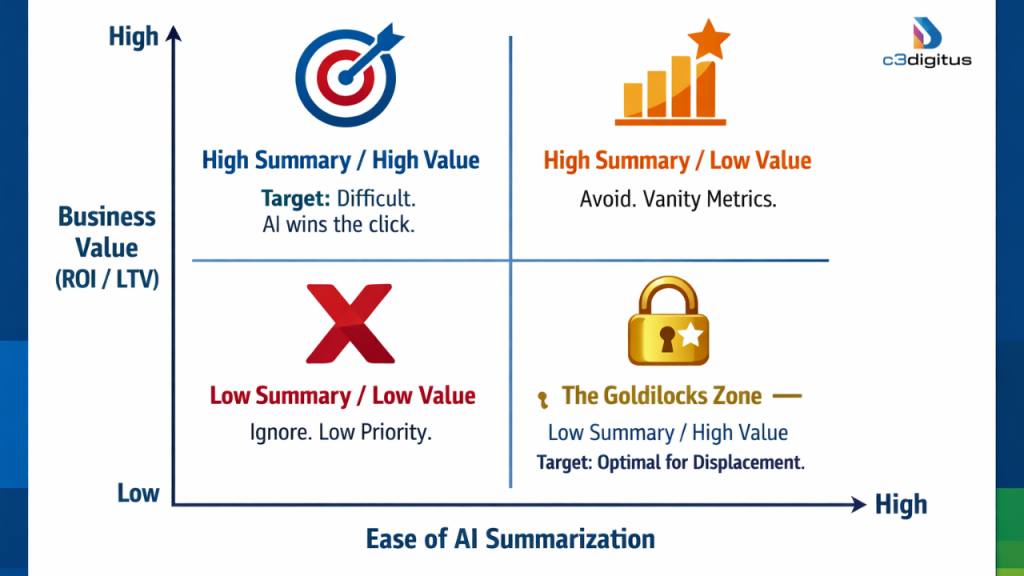
The "Goldilocks Zone" is your target for 2026. This matrix visualizes how C3 Digitus identifies keywords that are high in commercial value but complex enough that Google’s AI cannot fully summarize them, forcing the user to click through to your site for the full solution.
Phase 2: Exploiting the "Power Pack" for Rapid Entry
While SEO is a long-game investment, U.S. brands are increasingly utilizing what Google calls the "Power Pack": the integration of Performance Max (PMax), Demand Gen, and AI Max for Search.
Intercepting the "Commercial Friction"
If a competitor is dominating organic rankings for a lucrative category, you can "steal" that traffic visibility immediately. Current Google Ads updates allow for "High Value Mode" in PMax, which uses AI to bid more aggressively on users likely to have a high lifetime value (LTV).
By analyzing which of your competitors' keywords have the highest "commercial friction" (long sales cycles, high price points), you can deploy paid assets to intercept that traffic at the point of decision. This prevents the competitor from enjoying the full ROI of their organic position by offering a more compelling, immediate alternative in the sponsored slots.
Phase 3: The Long-Tail Offensive & Voice Search
As voice-based AI assistants like Gemini and Siri evolve into "buying agents," U.S. consumer behavior has shifted toward natural language. Most legacy competitors are still optimized for fragmented, short-tail keywords like "legal software."
This creates a massive opening. To dominate the conversational space, you must master what long tail keywords are in the context of "question-and-answer" architecture.
Optimizing for "Buying Agents"
AI agents don't just look for keywords; they look for Entities. If a user asks, "Siri, what is the best CRM for a US-based manufacturer needing CPRA compliance?", the AI looks for a site that satisfies:
- Specificity: Does the site mention "Manufacturing" and "CPRA"?
- Logic: Is the content structured in a way that the agent can "read" the answer?
By the time a competitor realizes they’ve lost this "fringe" traffic, you’ve already captured the highest-intent segment of their audience.
Phase 4: Strategic Displacement of "Zombie Content"
Many established U.S. enterprises are sitting on "Zombie Content" pages that rank well due to domain authority but haven't been updated to meet 2026's E-E-A-T standards (Experience, Expertise, Authoritativeness, Trustworthiness).
The Displacement Checklist
To execute a surgical displacement, audit your competitors for the following three weaknesses:
- Data Freshness: If a competitor’s data is pre-2024, they are a sitting duck. Google’s "Freshness Algorithm" in 2026 heavily weights recent, first-party research.
- Privacy Compliance: Under current FTC transparency rules and CPRA privacy expectations, transparency is a ranking signal. If a competitor’s page lacks clear disclosures or has a clunky cookie-consent UX, they will eventually be penalized.
- The Pivot (Alternative Pages): Use tools like G2 or [suspicious link removed] to find what users hate about your competitor. Create "Alternative to [Competitor]" pages that solve those specific pain points.
Phase 5: Technical Infrastructure for 2026
You cannot steal traffic if your site can't handle the "AI Crawl." In 2026, Crawl Budget is spent on LLM training bots as much as search bots.
- Schema Markup: You must use Schema.org Article & FAQ markup to tell AI agents exactly what your content is about.
- Fast-Pass Loading: If your site takes longer than 1.5 seconds to become interactive, AI Overviews may skip your "citation card" in favor of a faster source.
- Privacy-First Tracking: Ensure your analytics are GA4 compliant with zero-party data collection methods to maintain authority in the eyes of privacy-conscious algorithms.
The Takeaway for Decision Makers
Stealing competitor traffic in 2026 is a surgical operation. It requires a move away from "quantity" and a shift toward "utility." By prioritizing long-tail conversational queries and ensuring your technical infrastructure exceeds modern U.S. privacy and transparency standards, you don't just compete, you replace.
Your budget should reflect a 60/40 split between maintaining core "defensive" rankings and "offensive" content creation designed to fill the gaps your competitors have left behind.
Next Step: Competitive Gap Analysis
Would you like us to perform a deep-dive gap analysis on your top three competitors to identify exactly which "Zombie Content" pages we can displace this month?