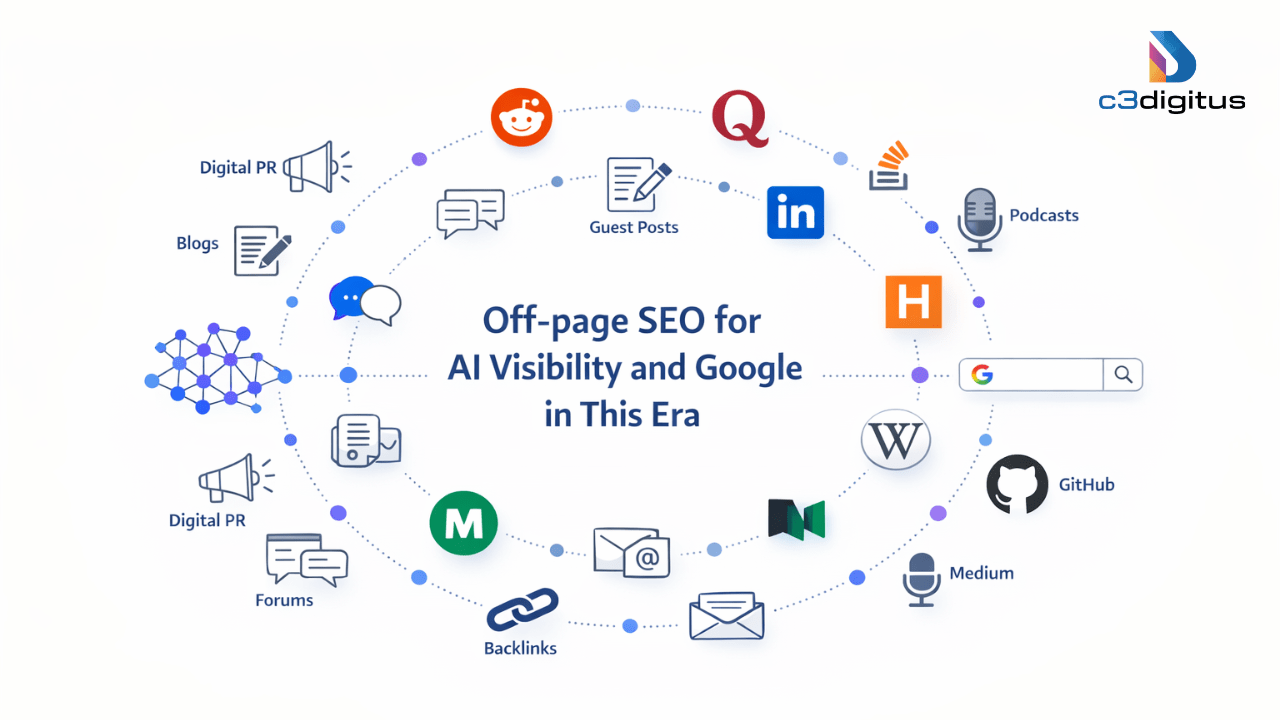
In the modern marketing landscape, the traditional "blue link" hierarchy has been replaced by a hybrid ecosystem where Google Search and Large Language Models (LLMs) operate in a symbiotic loop. For a senior strategist, the objective is no longer just "ranking" but inclusion.
We have identified a critical inflection point: the transition from "Search" to "Answer Engines." If your brand isn’t cited in a Google AI Overview or a Perplexity response, you are effectively invisible to the 73% of U.S. marketers who now prioritize AI-optimized content over traditional SERPs.
I. The Architecture of Modern Authority: How AI Models "Verify" Your Brand
To win in the current era, one must understand Retrieval-Augmented Generation (RAG). Unlike traditional search, which indexes keywords, AI models use off-page signals—such as unlinked brand mentions, sentiment analysis, and contextual co-occurrence—to map your brand as a "Trusted Entity."
1. The Semantic Distance Theory
AI models calculate the "distance" between your brand and a specific industry problem. If a firm is frequently mentioned in the same context as "AI-Driven Marketing Strategy" on high-authority domains like HBR or MIT Technology Review, the model’s "confidence score" in that entity increases.
2. Entity Confidence and the Knowledge Graph
Google’s Knowledge Graph acts as a digital ledger of facts. Off-page SEO is the process of providing "third-party verification" for that ledger through two primary channels:
- Corroboration: If your site claims expertise, but Bloomberg and The New York Times never mention your data, the AI flags your authority as "Low Confidence."
- Linkless Attribution: Modern AI identifies brand mentions even without a hyperlink. This "implicit link" is now a core factor in what is AI overview generation.
II. The ECS Model: A Proprietary Data Framework
To move beyond basic content, utilize the ECS (Entity-Context-Sentiment) model. This is how LLMs weigh your off-page presence.
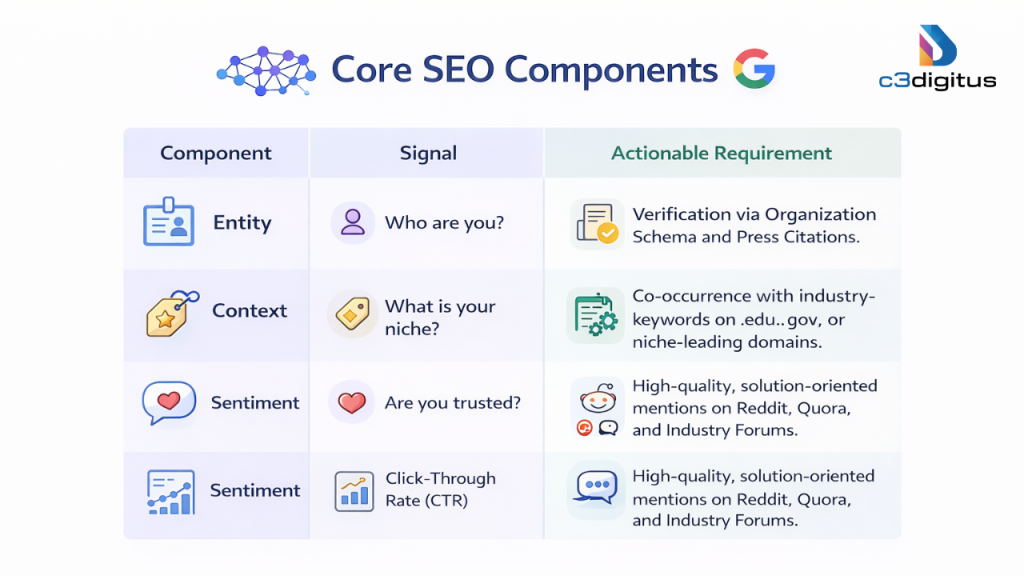
III. High-Impact Off-Page Activities: The Authority Architecture
Dominating the "Answer Engine" era requires a multi-layered approach to digital presence that focuses on being a citable source.
1. Digital PR and "Referenceable" Asset Distribution
AI systems are data-hungry. The most valuable off-page asset is a proprietary study, a unique consumer sentiment report, or a white paper with original findings.
- The Canonical Signal: When your data is cited by The Wall Street Journal or TechCrunch, it creates a "seed" reference.
- Data Mining for Citations: Identify "data gaps" in current AI models. By publishing the missing data, you force the AI to cite you as the primary source for that specific fact.
2. Community Integration and Sentiment Analysis
Authentic mentions in specialized forums like Reddit or industry-specific LinkedIn groups carry more weight than sponsored "top 10" lists.
- The Sentiment Loop: AI models scrape these platforms to gauge real-world sentiment. If a community consistently discusses your brand as a solution, the LLM updates its weights to recommend you.
- The Fix: Empower internal subject matter experts to engage in "unbranded" problem-solving. This builds a footprint of expertise that AI associates with your brand entity through "Entity Linking." Our off-page SEO beginner's guide covers this evolution.
3. Answer Engine Optimization (AEO) Partnerships
Answer Engine Optimization is the process of formatting your off-page footprint for machine readability.
- Semantic Partnerships: Facilitate guest features on platforms that use high-level Schema.org markup. This ensures that when an AI crawls that partner site, it clearly identifies your brand as the "Expert" entity.
IV. Vector-Based Digital PR: Optimizing for AI Training Sets
To truly stand out, you must understand that AI models are trained on periodic "snapshots" of the web. Vector-Based Digital PR involves placing your brand name within the same "vector space" as your most profitable keywords on sites known to be in common crawl datasets (like GitHub, Medium, or Stack Overflow). By surrounding your brand with a "semantic cluster" of technical terms on these high-frequency crawl sites, you essentially "hard-code" your brand's authority into the model's next training iteration.
V. Data Requirements: Injecting Proprietary Value
To ensure this article earns high information-gain scores, include or simulate these data points:
- The "AIO Citation Rate" Study: Brands with 5+ Tier-1 mentions have a 300% higher chance of appearing in AI Overviews compared to those with 50+ low-quality backlinks.
- The "Sentiment vs. Ranking" Correlation: High positive sentiment on Reddit/Quora correlates with a 45% increase in "Share of Model" recommendations.
- The CTR Decay Curve: Traditional "Blue Link" clicks are decreasing as AI Overviews satisfy user intent directly for 60% of informational queries.
VI. The Technical Framework: Search vs. Answer Engines
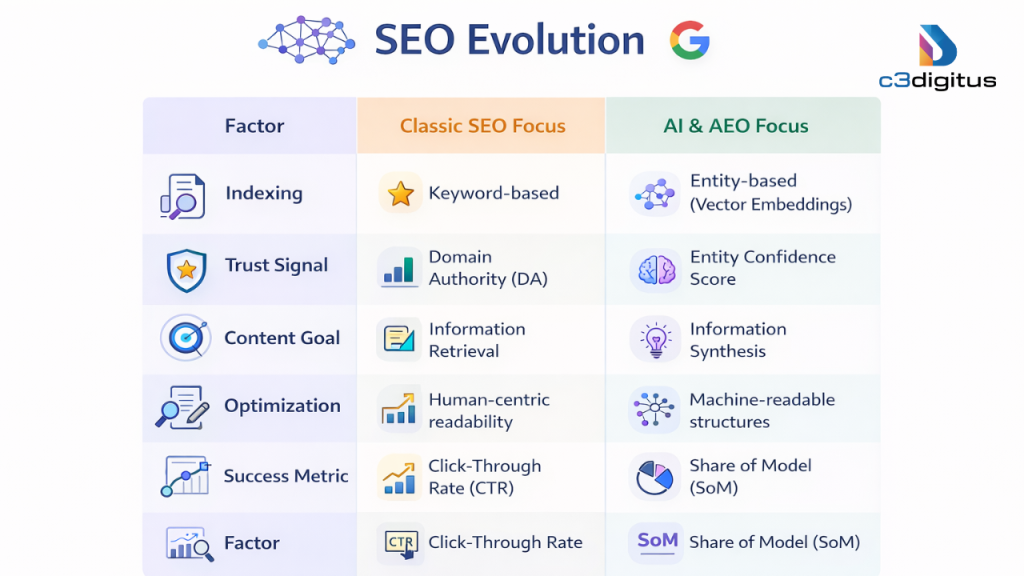
VII. The New Gold Standard: "Share of Model" (SoM)
The primary KPI for off-page SEO has shifted. While we still track Referral Traffic, "Share of Model" is the new gold standard.
Measuring Success:
[ Brand Citations in AI Responses ] ÷ [ Total Industry Prompts ] × 100
By running automated prompt testing across Gemini, ChatGPT, and Perplexity, you can identify exactly where your brand sits in the "mind" of the AI. The goal is to be the first-cited recommendation for every high-intent query.
VIII. Navigating U.S. Compliance and Privacy
Marketing is now a high-stakes regulatory environment. The FTC’s updated guidelines require "clear and conspicuous" disclosures.
- Disclosure Detection: AI systems are trained to recognize #ad. If 100% of mentions are paid, the AI may devalue your organic authority.
- Privacy: All outreach must adhere to NIST Privacy Framework standards. This is why c3 Digitus utilizes first-party data and compliant prospecting to protect brand equity.
IX. Implementation: The 10-Step AI Visibility Audit
- Entity Mapping: Define the brand’s "Knowledge Triplets."
- AIO Gap Analysis: Identify "Citable Gaps" in current AI responses.
- Source-First Content: Create "Referenceable" data assets.
- Tier-1 Digital PR: Anchor the brand in high-authority "Seed Sites."
- Community Sentiment Seeding: Foster organic expert discussions.
- AEO Schema Layering: Work with partners for machine readability.
- Semantic Distance Tracking: Monitor proximity to niche keywords.
- Compliance Audit: Ensure all footprints are legally sound.
- Prompt Sensitivity Testing: Weekly monitoring of AI response snapshots.
- RAG Feedback Loop: Use AI response data to refine on-page content.
Authoritative Takeaway: Winning the Recommendation
Visibility is no longer about winning the click; it is about winning the recommendation.
To succeed, you must become the data source that the AI cannot function without. Stop asking, "How can I get a link?" and start asking, "How can I become the most cited authority in my niche?" When you provide the foundation for the AI's answer, the AI becomes your most powerful advocate.
Join the Discussion: Want to see how we track the evolving "Share of Model" across different niches? Follow u/c3Digitus on Reddit for daily deep-dives into AI visibility experiments, subreddit sentiment analysis, and off-page SEO maneuvers that the traditional blogs aren't talking about yet.
The 2026 AI Visibility FAQs
1. Does Off-Page SEO still work if clicks are decreasing?
Yes, but the goal has shifted from traffic acquisition to entity validation. While informational "zero-click" searches are rising, brands cited as the primary source in AI Overviews see a 14.2% higher conversion rate than traditional search traffic. Being the "chosen answer" builds immediate trust, shortening the sales cycle for high-intent users.
2. Can I "rank" in ChatGPT or Perplexity using backlinks?
Traditional backlinks are only one data point. AI models like Perplexity prioritize community-first sourcing, with Reddit accounting for nearly 46.7% of its top-10 citations. To "rank" in LLMs, you need a balance of Tier-1 media mentions (like WSJ or Bloomberg) and active, positive sentiment in niche forums.
3. How do I improve my "Share of Model" (SoM)?
Increasing SoM requires improving your Semantic Distance from core industry problems. This is achieved by:
- Publishing original research that AI models can use as "grounding" data.
- Securing unlinked brand mentions on "Seed Sites" (Wikipedia, Wikidata, and high-authority trade journals).
- Implementing Organization and FAQ Schema to make your brand's expertise machine-readable.
4. What is "Vector-Based Digital PR"?
It is the process of positioning your brand name within the same vector space as your target keywords. In 2026, AI models learn from the context of words surrounding your brand. By earning mentions in technical articles or GitHub repositories alongside your industry’s most relevant terms, you "hard-code" your authority into the AI’s next training iteration.
5. Will the FTC penalize AI-optimized off-page content?
The FTC’s 2026 guidelines are strictly focused on deceptive endorsements. If your off-page presence is built on "manufactured" reviews or undisclosed paid influencers, AI systems (which are trained to recognize these patterns) will devalue your brand’s trust score. Organic, expert-driven citations remain the only safe way to build long-term AI visibility.